
Table of Contents
-
The Multiplier Effect: Quantifying the Financial Impact of a C-Suite Mis-hire
-
The PE Multiplier: How Leadership Failure Impacts Valuation and Exit Timelines
-
Root Causes of Executive Failure: Why High-Stakes Hires Miss the Mark
-
Mitigating Risk Through Human Capital Due Diligence and Partner-Led Search
The Multiplier Effect: Quantifying the Financial Impact of a C-Suite Mis-hire
Hiring a C-suite executive is one of the most consequential decisions a board or Private Equity firm can make. When it goes wrong, the fallout is far more than a simple HR error, it is a strategic impairment with a staggering financial impact. While common analysis often focuses on direct replacement costs, this view dramatically underestimates the true damage. A bad C-suite hire is not a line item expense, it is a multiplier that compounds negative value across an entire organization.
-
Defining the Mis-hire: A C-suite mis-hire is not just someone who underperforms, but a leader whose skills, style, or strategic vision are fundamentally misaligned with the company’s needs, leading to value destruction rather than value creation.
-
Direct Costs: The most visible costs include severance packages, recruitment fees for both the failed and subsequent search, and wasted onboarding and training investments.
-
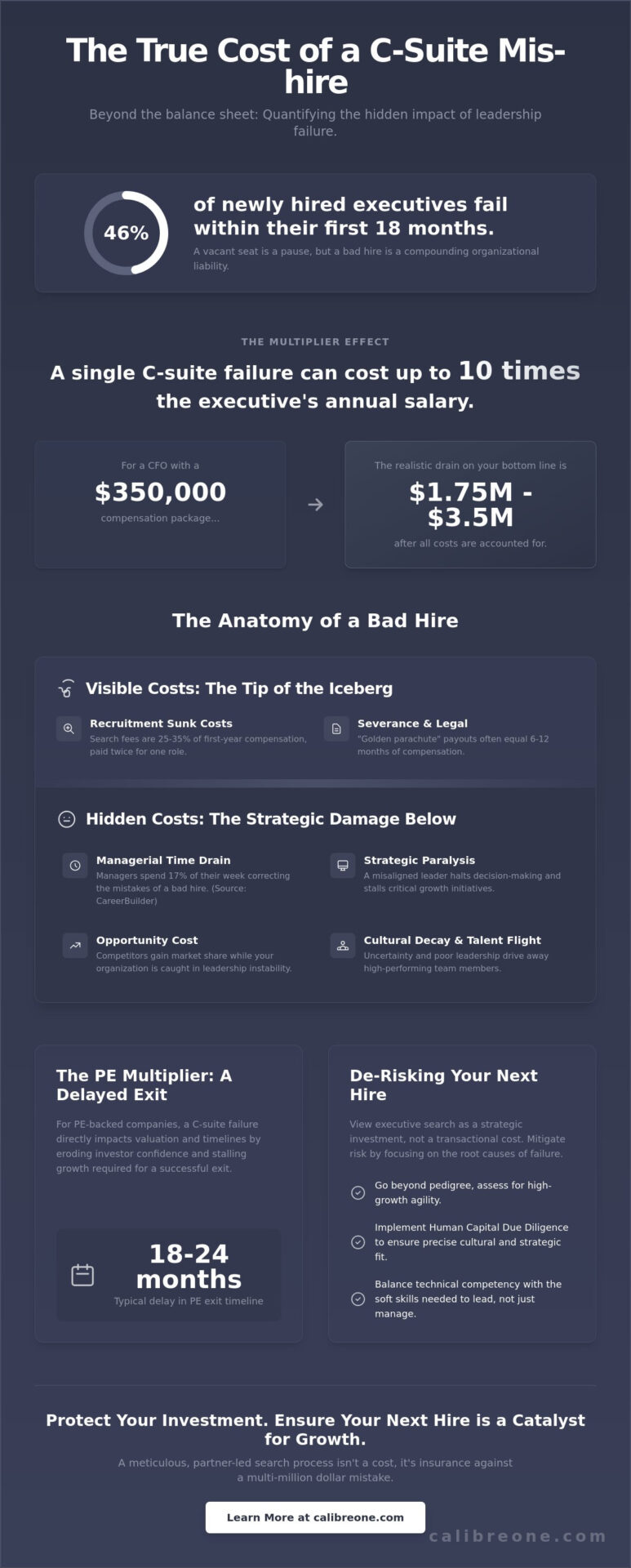
The Multiplier vs. Standard Metrics: While some studies suggest the cost of replacing a high-level employee is 213% of their annual salary, as reported by the Center for American Progress, this figure only scratches the surface for executive roles. Elite advisory firms and PE sponsors operate with a more realistic framework, calculating the total impact at 6 to 27 times the executive’s salary, a range discussed in leadership hiring literature like Geoff Smart and Randy Street’s book, "Who: The A Method for Hiring."
-
Inflated Exit Costs: Executive compensation structures, often laden with equity, performance bonuses, and long-term incentive plans, significantly inflate the cost of a negotiated exit, turning a bad hire into a multi-million dollar liability.
Direct vs. Indirect Financial Outlays
The financial bleeding from a failed executive hire occurs on multiple fronts, extending well beyond the salary. The direct costs are calculable and severe, representing a significant capital drain that could have been allocated to growth initiatives.
-
Doubled Recruitment Costs: The initial search represents a sunk cost. A second, corrective search not only doubles the direct recruitment fees but is often conducted under pressure, which can lead to further compromises if not managed with extreme diligence.
-
Golden Parachutes and Settlements: Negotiated exit packages for C-suite leaders, often called "golden parachutes," can include substantial severance pay, accelerated vesting of stock options, and other benefits. In contentious situations, legal settlement fees can further escalate these direct outlays.
-
Administrative and Board-Level Burden: The time and energy consumed by the board, senior leadership, and HR teams in managing the exit, stabilizing the team, and launching a new search is a significant, albeit often unquantified, cost. This diversion of focus is a direct tax on strategic progress.
The Opportunity Cost of Stalled Momentum
More damaging than the direct costs is the opportunity cost, the value of the future that was lost. A misaligned leader at the helm for 12 to 18 months can stall a company’s trajectory, a setback from which high-growth organizations may struggle to recover.
-
Lost Revenue and Market Share: A flawed go-to-market strategy, a delayed product launch, or the failure to enter a new market are common consequences of poor executive leadership. This doesn’t just mean lost revenue in the present, it can mean a permanent loss of market position to more agile competitors.
-
Strategic Continuity: To avoid the high costs of a failed marketing strategy during leadership transitions, growth-oriented firms can explore Fractional CMO Services from experts like Carissa Newton Creative, ensuring leadership stability and continued market expansion.
-
Eroded Investor Confidence: For PE-owned companies, leadership instability is a major red flag for investors. A high-profile mis-hire can complicate subsequent funding rounds, depress valuations, and damage the credibility of the board and sponsoring firm.
-
In the context of a 12-month failed tenure, opportunity cost is the total enterprise value that was not created due to strategic paralysis, operational drag, and market-facing missteps.
Strategic Paralysis and Cultural Decay: The Hidden Costs
Beyond the quantifiable financial metrics lies a more insidious category of damage. A bad C-suite hire can infect an organization’s strategic clarity and cultural health, with consequences that linger long after their departure. This "hidden" cost often proves to be the most difficult and expensive to repair, and organizations may need to discover Top7 for the strategic guidance and execution support required to overcome such critical growth obstacles.
-
Strategic Vacuum: A misaligned leader often creates a strategic vacuum. Indecisiveness, conflicting priorities, or a flawed vision can bring critical decision-making to a halt, leaving the entire organization adrift and unable to execute.
-
The "Talent Flight" Risk: High-performing employees have a low tolerance for poor leadership. A bad executive hire is a primary catalyst for talent flight, as your most valuable A-players, who are the most mobile, will be the first to leave.
-
Cultural Erosion: A toxic or ineffective leader can quickly erode a carefully cultivated company culture, replacing trust and collaboration with fear, politics, and disengagement. Rebuilding this trust and morale can take years of deliberate effort.
-
Reputational Damage: The failure of a senior leader is often a public event. It damages the company’s reputation among clients, partners, and future talent, creating a perception of instability and poor judgment.
The Ripple Effect on High-Performing Teams
The negative impact of a bad C-suite hire cascades down through the organization, disproportionately affecting the most committed and effective teams. The departure of a toxic leader is not the end of the problem, it is often just the beginning of a long recovery.
-
Secondary Turnover Costs: The cost of talent flight is not limited to the A-players who leave. You must then bear the cost of recruiting, hiring, and training their replacements, a significant expense that directly traces back to the initial mis-hire.
-
Productivity Collapse: Employee engagement is inextricably linked to leadership quality. A study by Development Dimensions International (DDI) found that 57% of employees have left a job specifically because of their direct manager. When that manager is a C-suite leader, the disengagement spreads, causing a measurable drop in productivity, innovation, and customer service. It’s an often-used saying that "people don’t leave bad jobs, they leave bad bosses."
-
Loss of Institutional Knowledge: When valued mid-level managers and senior individual contributors leave, they take with them years of institutional knowledge, customer relationships, and operational expertise that is difficult, if not impossible, to replace quickly.
Reputational Risk in the Technology Sector
In the hyper-competitive technology sector, where talent is the primary asset, the reputational cost of a leadership failure is particularly acute. A company’s ability to innovate is directly tied to its ability to attract and retain elite engineers, product managers, and data scientists.
-
The War for Talent: A high-profile executive mis-hire becomes a black mark on a company’s employer brand. In competitive talent hubs like Silicon Valley, New York, London and Berlin, the best candidates have multiple options and will actively avoid organizations with a reputation for leadership turmoil.
-
Leadership and Innovation: Attracting visionary leaders is fundamental to staying ahead in the tech landscape. Best-in-class talent wants to work for proven, inspiring leaders. A failed hire signals to the market that the board may not know how to identify or support such leadership.
-
Employer Branding Impact: The narrative of a failed C-suite hire can linger for years on platforms like Glassdoor and in industry circles. This damages the long-term employer brand, making it more difficult and expensive to attract top-tier talent at all levels of the organization.
The PE Multiplier: How Leadership Failure Impacts Valuation and Exit Timelines
For Private Equity firms, the cost of a bad C-suite hire is magnified exponentially. In the PE model, where value creation is measured against a defined investment timeline, leadership is the primary lever for driving growth and achieving a target IRR. A leadership failure is a direct threat to the entire investment thesis.
-
Leadership as the IRR Driver: In a PE portfolio company, the CEO, CFO, and other key executives are not just managers, they are the primary agents of the value creation plan. Their ability to execute on the strategic roadmap is the single most important variable in the fund’s success.
-
Delayed Exits: A C-suite mis-hire can easily delay a planned exit by 18-24 months. This disruption forces the PE firm to hold the asset longer, tying up capital and potentially pushing the exit into a less favorable market cycle, thereby compressing the fund’s overall returns.
-
The "Valuation Gap": When a new leader fails to hit critical growth milestones, revenue targets, or margin improvements, they create a "valuation gap," the difference between the projected enterprise value and the stalled reality. This gap represents millions of dollars in unrealized gains.
-
Strained Sponsor-Management Relations: A bad hire erodes trust between the PE firm’s operating partners and the portfolio company’s management team, creating friction and requiring a level of hands-on intervention that is both costly and inefficient.
EBITDA Impact and Multiple Compression
The financial impact on a PE-backed company can be measured directly through its effect on EBITDA and the subsequent valuation multiple. Poor leadership doesn’t just slow growth, it actively reduces the company’s profitability and perceived quality.
-
Direct EBITDA Reduction: Operational inefficiencies, bloated cost structures, failed sales strategies, and employee turnover all have a direct, negative impact on EBITDA. Every dollar of lost profit is a tangible reduction in the company’s core financial health.
-
Multiple Compression: Investors pay a premium for predictability and stability. A history of leadership turmoil introduces perceived risk, which can lead to multiple compression. The market will apply a lower valuation multiple to a company with a revolving C-suite door, as it signals underlying operational or governance issues.
-
A $1M drop in EBITDA can translate to a loss of $10M or more in enterprise value at a 10x exit multiple, illustrating the devastating leverage of a leadership failure.
Managing LP Expectations During Leadership Turmoil
The fallout from a failed executive search extends beyond the portfolio company to the PE firm’s own stakeholders, its Limited Partners (LPs). Explaining a significant write-down or a delayed exit due to a preventable mis-hire is a difficult and reputation-damaging conversation.
-
Credibility with LPs: Limited Partners invest in a PE firm based on its track record of operational excellence and its ability to install high-performing leadership. A failed C-suite placement calls this core competency into question.
-
Demonstrating Diligence: PE firms must demonstrate a rigorous, defensible process for leadership selection to maintain LP confidence. Partnering with a search firm that understands the unique demands of PE ownership and the need for proven leadership for PE clients is a critical part of this governance.
-
The Cost of "Re-Work": When a portfolio company’s leadership fails, the PE firm’s operating partners are often forced to step in, spending immense time and resources to stabilize the business. This "re-work" is a costly diversion from their primary role of overseeing the entire portfolio.
Root Causes of Executive Failure: Why High-Stakes Hires Miss the Mark
Executive failures are rarely a surprise in hindsight. The warning signs are often present during the search process but are missed due to flawed assumptions, inadequate vetting, or a focus on the wrong criteria. Understanding these common pitfalls is the first step toward mitigating the risk.
-
"Big Company" vs. "High-Growth" Mismatch: A stellar resume from a Fortune 500 company does not guarantee success in a lean, fast-paced PE-backed environment. The skills required to optimize an established system are vastly different from those needed to build and scale a business.
-
Cultural Misalignment: Technical competency is table stakes. The most common reason for executive failure is a fundamental misalignment with the company’s culture, values, and communication style. A leader who cannot connect with and inspire their team is destined to fail, regardless of their past accomplishments.
-
Failure of "Referral-Only" Hiring: While networks are valuable, relying solely on personal referrals at the C-suite level is a high-risk gamble. This insular approach limits the talent pool and often bypasses the rigorous, objective vetting required for such a critical role.
-
Inadequate Vetting of Soft Skills: Standard interview processes are notoriously poor at evaluating soft skills like adaptability, resilience, and emotional intelligence. A failure to dig deeper into these behavioral traits often leads to friction with the board and the existing leadership team.
The Competency vs. Chemistry Trap
Boards and hiring committees often fall into the trap of over-indexing on a candidate’s resume (competency) while misjudging their fit and behavioral profile (chemistry). This imbalance is a leading cause of mis-hires.
-
The Resume as a Mask: Resumes are backward-looking documents that list accomplishments but reveal little about a candidate’s adaptability, learning agility, or self-awareness. They often mask a leadership style that is incompatible with the future needs of the business.
-
The "Halo Effect": The prestige of a candidate’s previous employer, such as a well-known tech giant or a blue-chip corporation, can create a "halo effect" that blinds recruiters and boards to potential red flags. Past success in one environment is not a wholly reliable predictor of future performance in another.
-
Overlooked Behavioral Traits: A checklist of often-overlooked traits essential for C-suite success in high-growth settings should include:
-
Humility: A willingness to learn and adapt.
-
Resilience: The ability to navigate setbacks without losing momentum.
-
Intellectual Curiosity: A drive to look beyond the status quo.
-
Calculated Risk-Taking: The judgment to make bold decisions with incomplete information.
Inadequate Human Capital Due Diligence
The core of the problem often lies in a search process that lacks true diligence. Many organizations treat executive hiring like a standard recruitment function rather than the high-stakes capital allocation decision that it is.
-
Standard vs. Deep-Dive Vetting: Standard background checks and reference calls are insufficient. True Human Capital Due Diligence involves deep, 360-degree referencing, behavioral assessments, and scenario-based interviews designed to pressure-test a candidate’s leadership capabilities in real-world contexts.
-
Hiring for "What" vs. "How": A flawed process focuses on "what they’ve done," ticking boxes on a job description. A rigorous process focuses on "how they’ll lead here," evaluating their ability to adapt their skills to a new and unique organizational context.
-
Lack of Pre-Search Alignment: The most critical errors often occur before the search even begins. A failure to achieve complete alignment among the board, investors, and the executive team on the specific competencies, leadership style, and 18-month objectives for the role sets the search up for failure from the start.
Mitigating Risk Through Human Capital Due Diligence and Partner-Led Search
Now for the self-serving point. The immense cost of a bad C-suite hire makes a compelling case for investing in a rigorous, partner-led search process grounded in deep due diligence. Preventing a mis-hire is exponentially more valuable than recovering from one. This requires a shift in mindset, from viewing executive search as a transactional cost to seeing it as a critical form of investment insurance.
-
Partner-Led Search: It is my firm belief that many searches fail due to the individuals that lead them. It’s critically important for clients that the most experienced minds are guiding the search. This is a direct safeguard against the volume-driven, process-light approach of larger search "factories" where junior associates often handle critical interactions.
-
Human Capital Due Diligence: This formalized process quantifies leadership risk before an offer is made. It goes beyond the resume to assess a candidate’s behavioral DNA, ensuring a precise fit with the company’s culture and strategic objectives.
-
Global Reach for Specialized Talent: In today’s market, the ideal candidate may be anywhere in the world. A firm with a global network and deep industry specialization is essential for finding truly elite talent, especially for niche or highly technical sectors.
-
Post-Hire Integration Support: The work isn’t over when the contract is signed. A structured 100-day onboarding and integration plan is crucial for ensuring the new leader is set up for long-term success, helping to secure the investment made in their recruitment.
The Boutique Advantage in Executive Search
In a high-stakes executive search, the methodology and philosophy of the search partner are paramount. A boutique firm’s focus on depth over breadth provides a distinct advantage in preventing costly mis-hires.
-
Attentive, Partner-Led Delivery: Unlike large, scaled firms, a boutique model provides direct access to senior partners who bring decades of experience and nuanced judgment to every search. This high-touch approach ensures meticulous attention to detail at every stage.
-
Deep Industry Specialization: True expertise prevents mis-hires. A deep understanding of specific sectors allows a search partner to assess candidates not just on general leadership skills but on the specific domain knowledge and network required to succeed.
-
Commitment to Outcomes: Boutique firms are built on reputation and long-term partnerships. Their success is directly tied to the success of the leaders they place, creating a powerful alignment of interests with the client.
Implementing a Rigorous Succession and Search Framework
A proactive and structured framework for leadership transitions is the ultimate risk mitigation strategy. This involves both planning for the future and executing searches with uncompromising rigor.
-
Board-Level Alignment: The process must begin with a facilitated session at the board and investor level to define the role’s scorecard, agree on the ideal candidate archetype, and build consensus on the non-negotiable cultural attributes.
-
Behavioral Assessments and 360-Degree Referencing: Move beyond conversational interviews. Use psychometric and behavioral assessment tools to create objective data points. Conduct exhaustive, off-list reference checks that provide an unvarnished view of a candidate’s past performance and leadership style. For more on this, see our guide on strategic C-suite succession planning.
-
Ultimately, the investment in a premium, diligence-led executive search is a mere fraction of the catastrophic financial and strategic cost of getting it wrong.