
Within the world of Private Equity, the Chief Financial Officer is the central architect of value creation. As PE firms navigate the complex 2026 landscape of shifting interest rates, intense competition, and accelerated exit timelines, the demands on financial leadership have fundamentally evolved. Recent industry analysis from leading executive search firms indicates that CFO turnover within PE portfolio companies can be as high as 60-70% within the first two years post-acquisition, a figure in-line with our own observations and that underscores a critical misalignment between sponsor expectations and executive capabilities. This guide provides a strategic framework for PE operating partners and portfolio company CEOs to identify, attract, and empower the modern CFO required to drive alpha and secure a premium exit.
Table of Contents
-
Defining the CFO for Private Equity portfolio companies in 2026
-
Core competencies: Beyond financial reporting to value creation
-
PE vs. Public: Why the portfolio CFO requires a different DNA
-
The search for excellence: Attracting and retaining elite financial talent
-
Optimizing your leadership team for exit readiness and growth
Defining the CFO for Private Equity portfolio companies in 2026
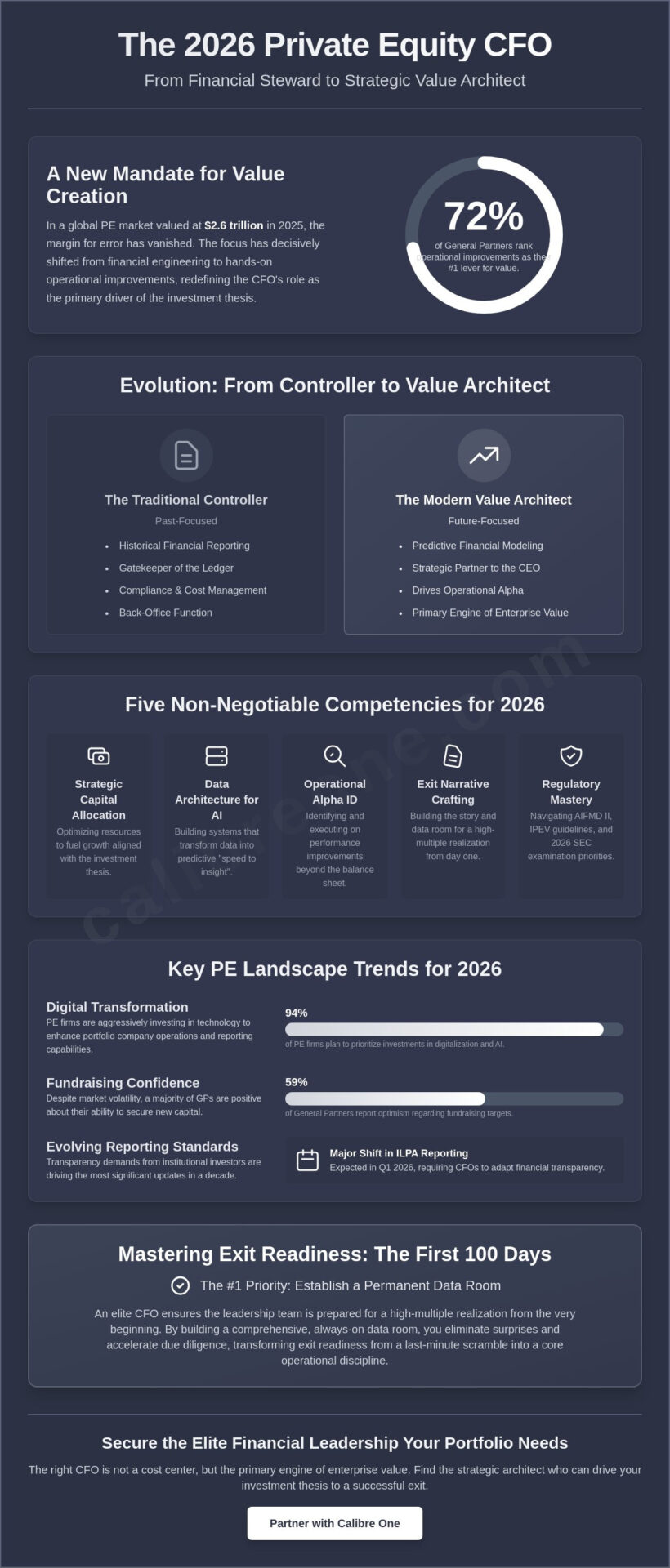
The primary role of a CFO for a private equity portfolio company is to drive the investment thesis. The modern CFO not only reports on past performance but actively shapes the future of the business. In an environment where capital is more discerning and growth assumptions are under constant scrutiny, the CFO must transition from historical accounting to predictive, data-driven modeling. This requires a leader who serves as a true strategic peer to the CEO and a trusted partner to the PE sponsor, capable of translating operational data into financial outcomes and managing complex, often leveraged, capital structures with precision.
-
Architect of the Investment Thesis: The CFO’s primary mandate is to translate the PE firm’s investment goals into an operational and financial reality.
-
Predictive, Not Historical: The 2026 environment demands a forward-looking perspective, using data analytics and predictive modeling to anticipate market shifts and operational challenges.
-
A Strategic Peer: This leader operates at the same strategic altitude as the CEO, providing the financial rigor and data-driven insights that inform every major decision.
-
Capital Structure Management: In a dynamic interest rate market, the CFO must adeptly manage leverage, covenants, and cash flow to fuel growth without introducing undue risk.
The evolution from controller to value architect
The traditional view of a CFO centered on financial oversight, compliance, and reporting is now insufficient for the demands of PE ownership. The modern portfolio company CFO is a value architect, tasked with driving operational alpha, not just tracking it. This shift explains why PE firms are increasingly installing new financial leadership earlier in the investment lifecycle, often within the first 100 days. They recognize that a world-class finance function is the engine of value creation. This expanded mandate often includes oversight of adjacent functions like IT, HR, and Legal, as the CFO is uniquely positioned to connect disparate parts of the organization through the common language of data and financial impact.
Why the investment thesis dictates the CFO profile
There is no one-size-fits-all profile for a successful PE CFO. The ideal candidate is dictated entirely by the investment thesis. A "buy-and-build" strategy requires a CFO with deep M&A integration experience, while a pure organic growth play demands expertise in scaling systems and building commercial finance capabilities. The "Turnaround CFO" brings a skill set focused on cost control, cash management, and operational restructuring, which is distinct and must excel at capital allocation for market expansion and product innovation. Navigating these transitions requires a nuanced understanding of how to align financial strategy with specific market opportunities, a hallmark of sophisticated financial services leadership.
Core competencies: Beyond financial reporting to value creation
While impeccable financial reporting remains the foundation, the elite CFO for a Private Equity portfolio company builds upon it with a suite of competencies geared toward active value creation. The high-velocity PE environment demands "speed to insight," the ability to quickly analyze data, identify key levers, and communicate a clear, actionable narrative to the board and sponsors. This narrative is not just for internal consumption, it is the story that will ultimately be told to potential buyers or public markets. The increasing demand for data-literate CFOs is a direct result of the industry-wide push for digital transformation, where finance is expected to lead, not follow.
-
Top Five Non-Negotiable Skills: Strategic M&A execution, advanced cash flow management, digital finance transformation, capital allocation strategy, and exit narrative construction.
-
Speed to Insight: The ability to translate complex data sets into clear, decisive actions is paramount in a fast-paced PE environment.
-
Crafting the Exit Narrative: The CFO must begin building the story of the company’s value and growth trajectory from day one, preparing the data and metrics for the eventual exit.
-
Data Literacy as a Prerequisite: A deep understanding of AI, data analytics, business intelligence tools, and financial modeling is no longer a bonus, it is a core requirement.
Strategic M&A and capital allocation expertise
Digital transformation and the tech-enabled finance function
The 2026 finance function is a technology-enabled hub of business intelligence. The modern PE CFO must champion the adoption of AI, machine learning, and automation to streamline reporting, enhance forecasting accuracy, and free up the finance team for more strategic, value-added activities. This requires a CFO who is not just a consumer of technology but a leader capable of partnering with the CTO to drive organizational efficiency. The era of static, monthly reporting packs is over, replaced by a demand for real-time dashboards that provide PE sponsors with immediate, transparent insight into portfolio company performance. This convergence of finance and technology leadership is a defining feature of the modern CFO role.
PE vs. Public: Why the portfolio CFO requires a different DNA
The assumption that a successful public company CFO can seamlessly transition into a PE-backed role is a common and costly mistake. The two environments demand fundamentally different skills, mindsets, and operational styles. The reporting cadence in PE is more frequent, more detailed, and directed at a small, highly sophisticated audience of financial sponsors. This "high-velocity" environment, characterized by rapid decision-making and intense pressure to perform against the investment thesis, requires a unique blend of strategic acumen and hands-on execution. Furthermore, the equity-heavy compensation structures in PE create a powerful alignment of interests between the CFO and the sponsor, fostering an "owner-operator" mentality that is often absent in larger public corporations.
PE CFO vs. Public Company CFO: A Comparative Analysis
| Attribute | CFO for Private Equity Portfolio Company | Public Company CFO |
|---|---|---|
| Primary Audience | PE sponsors, deal partners, lenders | Equity research analysts, institutional investors, retail shareholders |
| Reporting Cadence | Weekly or bi-weekly dashboards, monthly deep dives | Quarterly earnings calls, annual reports |
| Key Metrics | IRR, MOIC, cash flow, covenant compliance, EBITDA growth | Earnings Per Share (EPS), revenue growth, stock price |
| Decision Speed | High-velocity, immediate action required | Deliberate, consensus-driven, committee-based |
| Resource Environment | Lean, resource-constrained, "do more with less" | Large, established teams, specialized functions |
| Compensation Driver | Equity value creation, successful exit | Annual bonus, stock options, long-term incentive plans (LTIPs) |
| Strategic Focus | Executing a 3-5 year investment thesis for a specific exit | Long-term sustainable growth, quarterly guidance |
Navigating the sponsor-portfolio relationship
Success as a portfolio company CFO hinges on mastering the unique relationship between the CEO, the CFO, and the PE deal partner. The CFO must be fluent in "speaking the language of the sponsor," translating operational results into the metrics that matter most to them, such as Internal Rate of Return (IRR) and Multiple on Invested Capital (MOIC). This requires a level of transparency and reporting depth that goes far beyond standard GAAP accounting, providing granular detail on the key drivers of business performance.
Operational grit vs. corporate oversight
The search for excellence: Attracting and retaining elite financial talent
The competitive landscape for elite financial talent in 2026 is intense, with high turnover rates reflecting the immense pressure and unique demands of the role. Traditional headhunting methods, which often rely on keyword searches and surface-level assessments, are frequently insufficient for identifying candidates with the specific blend of technical skill and cultural fit required for PE success. A more sophisticated approach is needed, one that incorporates rigorous behavioral assessments to predict how a candidate will perform under pressure. Leading PE firms now view human capital due diligence as a critical step in de-risking a new investment, recognizing that a bad leadership hire can be one of the most significant threats to achieving their targeted returns. The cost of a failed C-suite hire goes far beyond recruitment fees, impacting morale, momentum, and the ultimate valuation of the asset.
Structuring the executive search process for speed and precision
While a standard corporate C-suite search may take six to nine months, the PE world operates on an accelerated timeline. An effective search process must be structured for both speed and precision, typically concluding within 90-120 days. This requires a partner-led delivery model where experienced search professionals are actively engaged in every stage, from building a diverse and high-calibre candidate pool to securing the interest of passive, elite candidates who are not actively looking for a new role. The ability to articulate the unique wealth creation opportunity and align it with a candidate’s career ambitions is key to winning the war for talent.
Compensation and alignment in 2026
Compensation for a CFO for a Private Equity portfolio company is structured to create direct alignment with the sponsors. While base salary and annual bonuses are competitive, the primary motivator is the LTIP tied to the exit. This is typically delivered through a significant equity stake – normally sweet equity – or a synthetic equity instrument like a Management Incentive Plan (MIP). This structure ensures the CFO is singularly focused on driving enterprise value. Sophisticated retention packages are also crucial, designed to ensure that the key financial leader who understands the business intimately remains in place through the demanding and often distracting exit process.
Optimizing your leadership team for exit readiness and growth
The CFO’s impact is most pronounced during two critical phases: the "First 100 Days" post-acquisition and the final 12-18 months leading up to an exit. In the initial phase, the CFO is responsible for establishing financial control, implementing PE-grade reporting, and identifying quick wins. As the exit horizon approaches, their role shifts to preparing the company for the intense scrutiny of a sale or IPO. A high-performing CFO begins building the "data room" years in advance, ensuring that all financial, operational, and legal documentation is clean, audited, and readily available. This proactive approach to exit readiness can significantly accelerate the transaction timeline and maximize valuation. Moreover, great CFOs focus on leadership succession planning within their own function, ensuring stability and continuity for the business post-exit.
The CFO roadmap to exit readiness
The path to a successful exit is a meticulous process managed by the CFO. It involves a detailed financial "clean-up" to ensure all reporting is pristine and can withstand the rigors of third-party due diligence. The CFO orchestrates the work of external advisors, including investment bankers, auditors, and legal counsel, acting as the central point of contact. Critically, they must also maintain operational momentum and keep the management team focused on hitting performance targets, even as the demands of the exit process consume significant time and attention. This dual focus is the hallmark of an elite, exit-ready CFO.
Partnering with Calibre One for strategic search
Securing the right financial leadership is one of the most critical decisions a PE sponsor will make. The stakes are too high for a generic approach to recruitment. Calibre One offers a discerning, partner-led methodology specifically designed for the unique demands of C-suite recruitment in Private Equity. We combine the global reach of a major firm with the deep industry expertise and bespoke service of a boutique. Our focus on the technology, financial services, and other high-growth sectors gives us unparalleled access to a network of proven, value-oriented leaders. We invite you to engage with us for a consultation on your portfolio leadership needs and discover how the right CFO can transform your investment thesis into a high-multiple reality.
Frequently Asked Questions
What is the difference between a CFO and a Controller in a PE-backed company?
A Controller is primarily focused on historical accounting, compliance, and financial reporting accuracy. They "close the books." A CFO for a Private Equity portfolio company is a forward-looking, strategic partner who uses financial data to drive business decisions, manage investor relationships, and execute the investment thesis. The CFO is focused on value creation, while the Controller ensures financial integrity.
How much experience does a Private Equity CFO typically need?
There is no single answer, but most successful PE CFOs have 15-20+ years of progressive financial experience. Crucially, they need prior experience in a PE-backed or similarly high-growth, leveraged environment. Previous roles as a VP of Finance, a divisional CFO, or a CFO in a smaller, fast-paced company are common pathways.
Why is turnover so high for CFOs in Private Equity portfolio companies?
Turnover is high due to a frequent mismatch of skills and expectations. A CFO from a large, stable public company may lack the "operational grit" and speed required for PE. Conversely, a CFO without experience managing sponsor relationships and the demanding reporting cadence may struggle. The role’s intensity and the direct link between performance and the exit outcome create immense pressure.
What are the most important KPIs a PE CFO should track in 2026?
Beyond standard metrics like Revenue and EBITDA, the most important KPIs include: Cash Flow Conversion, the 13-Week Cash Flow Forecast, Net Debt to EBITDA (leverage ratio), Customer Acquisition Cost (CAC) to Lifetime Value (LTV) ratio, and specific operational drivers tied directly to the investment thesis (e.g., net revenue retention for a SaaS business).
Do PE portfolio CFOs need specific industry experience?
While not always mandatory, specific industry experience is highly advantageous. It allows the CFO to understand the unique unit economics, competitive landscape, and value drivers of the business much faster. For complex sectors like technology or healthcare, it is often a critical requirement for credibility with the board and investors.
How does the compensation for a PE CFO differ from a public company CFO?
PE CFO compensation is heavily weighted toward long-term equity value creation. While base salary and bonus may be comparable or slightly lower than in a large public company, the potential payout from their equity stake upon a successful exit can be significantly larger. This structure creates a powerful alignment with the PE sponsor’s financial goals.
What role does the CFO play in Private Equity due diligence?
On the buy-side, a CFO might be brought in as an advisor to assess a target’s financial health and systems. On the sell-side, the portfolio company CFO is the central figure who prepares all financial data, builds the financial model for the investment bank, and leads the company’s response to the buyer’s rigorous financial due diligence questions.
How long does it typically take to hire a CFO for a portfolio company?
An accelerated, focused search process for a PE portfolio company CFO should ideally be completed within 90 to 120 days. The urgency is driven by the need to install strong financial leadership quickly post-acquisition to begin executing the value creation plan without delay.