
Table of Contents
-
Founder-Led vs Professional Management: Navigating the Scalability Gap
-
Building Resilience Through Succession Planning and Board Governance
-
Strategic Partnering: How Calibre One Minimises Human Capital Volatility
Understanding the High Stakes of Leadership Risk in PE
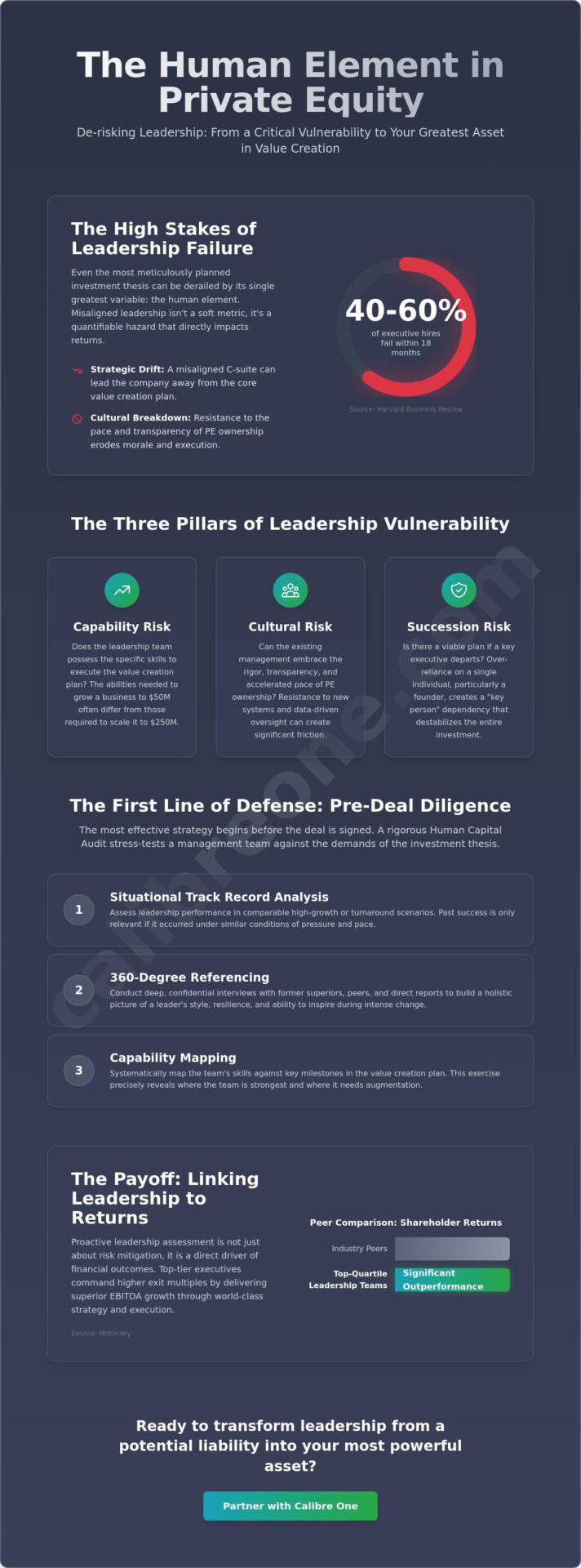
For a Private Equity investor, the value creation plan provides the roadmap to a target exit multiple. Every assumption, from operational efficiencies to market expansion, is meticulously modelled. Yet, the single greatest variable, and the most common point of failure, is often the human element. Leadership risk is the critical, and frequently underestimated, vulnerability that exists between executive capability and the strategic demands of the investment thesis. It is not a soft metric but a quantifiable investment hazard that can derail even the most promising deal.
The financial consequences of getting leadership wrong are severe. Research published in Harvard Business Review indicates that between 40% and 60% of high-level executive hires fail within 18 months, a statistic that can carry devastating financial and operational consequences. In the high-velocity world of PE, where a finite hold period leaves no room for error, the impact is magnified. A misaligned leader can erode value through strategic drift, poor execution, and cultural breakdown, making the difference between a top-quartile return and a write-down.
Traditional recruitment methods, often focused on resume keywords and past accomplishments, are ill-equipped to predict success in this environment. They frequently fail to distinguish between technical competence-the ability to perform a job-and the specific behavioural traits required for rapid, PE-backed transformation. These roles demand a unique combination of resilience, pace, data-driven decision-making, and an ability to thrive under intense scrutiny, qualities that are not always evident on paper.
The Three Pillars of Leadership Vulnerability
Mitigating leadership risk in portfolio companies requires a structured approach that assesses vulnerability across three core pillars:
-
Capability risk: Does the current leadership team possess the specific skills and experience to execute the value creation plan? A CEO who successfully grew a business to $50 million may not have the capabilities needed to scale it to $250 million, a common challenge in the lower middle market.
-
Cultural risk: Will the existing management team embrace the rigour, transparency, and accelerated pace of PE ownership? Resistance to new reporting structures, data-driven oversight, and strategic shifts can create significant friction and undermine growth initiatives.
-
Succession risk: Is there a viable and immediate plan if a key executive departs unexpectedly? Over-reliance on a single leader, particularly a founder, creates a "key person" dependency that can destabilise the entire investment.
Linking Human Capital to Investment Returns
The Operating Partner often plays a pivotal role in bridging the gap between the Board’s strategic objectives and the management team’s daily execution. However, their effectiveness depends on having the right leadership in place. By treating human capital with the same analytical rigour as financial statements, PE investors can transform a potential liability into their most powerful asset for value creation.
Human Capital Due Diligence: The First Line of Defence
The most effective strategy for mitigating leadership risk begins before the deal is even signed. Integrating human capital due diligence into the pre-deal phase allows investors to identify and price in hidden management liabilities, providing a clear-eyed view of the team’s ability to execute the post-acquisition plan. This process moves far beyond simple background checks and surface-level interviews, delving into the behavioural, cognitive, and cultural makeup of the leadership team.
A primary goal of this early-stage assessment is to identify the "founder gap"-a common scenario where a visionary founder has built a successful business but may lack the operational or financial experience required for the next stage of institutional growth. By evaluating the leadership team as a collective, cohesive unit rather than a collection of individual resumes, PE firms can spot crucial gaps in capability and anticipate potential points of friction. The consequences of a misaligned C-suite executive can be catastrophic, a topic we explore further in our guide on mitigating the true cost of a bad C-suite hire.
The Audit Process: What to Look For
A rigorous human capital audit is a multi-faceted process designed to stress-test a management team against the specific demands of the investment thesis. Key components include:
-
Situational Track Record Analysis: Assessing the track record of leaders in comparable high-growth, turnaround, or post-merger integration scenarios. Past success is only relevant if it occurred under similar conditions of pressure and pace.
-
360-Degree Referencing: Conducting deep, confidential interviews with former superiors, peers, and direct reports to build a holistic picture of a leader’s style, resilience, and ability to inspire a team during periods of intense change.
-
Capability Mapping: Systematically mapping the management team’s skills and experiences against the key milestones outlined in the value creation plan. This exercise reveals where the team is strongest and where it needs augmentation.
Leveraging Data in Leadership Assessment
While leadership assessment involves nuanced human judgment, it should be anchored in objective data to remove bias and increase predictive accuracy. Modern due diligence leverages sophisticated tools to quantify risk factors that are otherwise subjective.
-
Psychometric and Cognitive Testing: Using validated assessment tools to measure traits like learning agility, strategic thinking, resilience, and resistance to change. These instruments provide a baseline for a leader’s potential to adapt and scale with the business.
-
Industry Benchmarking: Comparing the current team’s capabilities and composition against high-performing leadership teams in the same sector. This helps set a clear standard for what "good" looks like and identifies areas for development or upgrade.
-
Identifying "Uncoachable" Traits: Data can help flag deeply ingrained behavioural patterns, such as low self-awareness or an inability to accept feedback, that could derail coaching efforts and poison the C-suite culture post-close.
Founder-Led vs Professional Management: Navigating the Scalability Gap
One of the most delicate challenges in PE is managing the transition of a founder-led business. While founders bring invaluable passion, product knowledge, and industry relationships, the very skills that made them successful entrepreneurs can become liabilities under a PE ownership model that demands scalable systems, financial discipline, and shared governance.
The transition from a founder’s absolute control to a PE-led governance structure is fraught with emotional and operational hurdles. A comprehensive study from Equiteq and the University of Chicago Booth School of Business revealed that a staggering 73% of founder CEOs are replaced within the first few years of a PE-backed deal, underscoring the prevalence of this scalability gap. The key is not to view this as an inevitable conflict but as a transition to be managed proactively and strategically, often by augmenting the founder with professional management, such as a "professional" CEO or a strategic CFO, to instill the necessary rigour.
Identifying the Tipping Point for Management Change
Recognising when a leader has reached their ceiling is crucial for protecting the investment. The signs are often subtle at first but can quickly escalate if ignored:
-
A shift from strategic, forward-looking work to being constantly mired in day-to-day operational details.
-
An inability to build and empower a strong second layer of management, leading to decision-making bottlenecks.
-
A failure to appreciate the importance of robust financial reporting, forecasting, and KPI management.
The foundation for a successful transition is laid during the pre-acquisition phase through honest, transparent conversations between the PE firm and the founder. By creating a clear transition roadmap that respects the founder’s legacy, perhaps by moving them into a Chairman or Chief Innovation Officer role, the firm can retain their valuable institutional knowledge while bringing in the leadership required for the next chapter of growth.
Balancing Innovation with Operational Excellence
In many cases, the optimal solution is not replacement but augmentation. PE firms often find success by pairing a visionary, product-focused founder with an operationally-minded COO or President who excels at execution and process improvement. This "visionary-integrator" model allows the company to benefit from the founder’s innovative spirit while building the scalable infrastructure needed for profitable growth.
Building Resilience Through Succession Planning and Board Governance
Once the initial leadership team is in place, the work of mitigating leadership risk shifts to a continuous process of governance, mentorship, and planning. The Board of Directors serves as the ultimate safeguard against strategic drift and performance decay, providing crucial oversight and holding the management team accountable to the value creation plan. Its role is not merely to monitor but to actively guide, challenge, and support the CEO.
A critical function of the Board is to implement a robust and continuous succession planning process. This goes beyond creating an emergency plan for an unexpected departure; it involves systematically identifying and developing the next generation of leaders within the organisation. For first-time PE-backed CEOs, an experienced Board, particularly an independent Chairman, can provide invaluable mentorship on navigating the unique pressures and reporting cadences of the PE environment, mediating potential conflicts and ensuring alignment between all stakeholders.
Proactive Succession: Beyond Emergency Planning
Effective succession planning is a strategic discipline that builds long-term organisational resilience. It ensures leadership continuity and maintains momentum during the hold period, which is essential for hitting growth targets. A proactive approach includes:
-
Internal Talent Mapping: Regularly assessing internal talent to identify high-potential individuals who can be developed for future C-suite roles. This creates a pipeline of leaders who already understand the business and culture.
-
Building an External Bench: Discreetly maintaining a "bench" of vetted, external candidates for critical positions. This dramatically reduces the time-to-fill for a key role should a vacancy arise, preventing costly leadership gaps. Proactive talent management is a cornerstone of long-term value creation, a discipline we detail in our strategic guide to C-suite succession planning in PE.
The Ideal PE Board Composition
The composition of the Board is a strategic decision that directly impacts its effectiveness in risk mitigation. A well-constructed Board provides a balance of perspectives and holds management accountable.
-
A Mix of Expertise: The ideal Board blends deep sector expertise with functional specialists in areas critical to the investment thesis, such as finance, technology, or go-to-market strategy.
-
The Power of Independent Directors: Including independent directors who are not affiliated with the PE firm or the company is crucial. They provide unbiased risk oversight, challenge assumptions, and can act as objective advisors to the CEO and the investment partners.
-
A Mandate for Accountability: The Board must have the "teeth" and the resolve to make tough decisions, including changing leadership if the value creation plan is at risk. Its primary fiduciary duty is to the shareholders.
Strategic Partnering: How Calibre One Minimises Human Capital Volatility
In the high-stakes environment of Private Equity, mitigating leadership risk is not a task to be delegated to generalist recruiters. It requires a strategic partner with deep domain expertise, a rigorous methodology, and a nuanced understanding of the unique demands of PE-driven transformations. Calibre One operates as a discerning partner to PE investors, providing the focused, senior-level engagement necessary to secure and optimise portfolio company leadership.
Our partner-led approach ensures that every assignment receives the highest level of strategic attention, combining the focus and meticulous detail of a boutique firm with the global reach required for cross-border PE portfolios. With a rich heritage in the technology and high-growth sectors that are often the focus of PE investment, we bring a differentiated perspective to leadership risk assessment.
Bespoke Search for Complex Transformations
We believe that elite executive search is not about filling a role but about finding the specific leader who can execute a precise investment thesis. Our methodology is designed to assess not only for capability but for the behavioural alignment and cultural fit essential for success within a PE-backed company.
-
We go beyond the resume to evaluate a candidate’s resilience, pace, and data-driven mindset.
-
Our process ensures a deep alignment between the leader’s motivations and the PE firm’s goals for value creation.
The Calibre One Advantage: A Discerning Strategic Partner
Our commitment is to act as a peer to the C-suite and the Board, engaging as strategic advisors who are deeply invested in the outcome of every leadership decision. We understand that in the world of PE, there is no margin for error. This understanding drives our commitment to meticulous detail and unwavering standards in every human capital assignment we undertake.
-
We provide the candid, data-backed counsel that PE investors need to make confident leadership decisions.
-
Our partner-led model guarantees accountability and senior-level expertise from start to finish.
-
Explore our track record of success with our clients and discover how a strategic partnership can protect and enhance your portfolio returns.