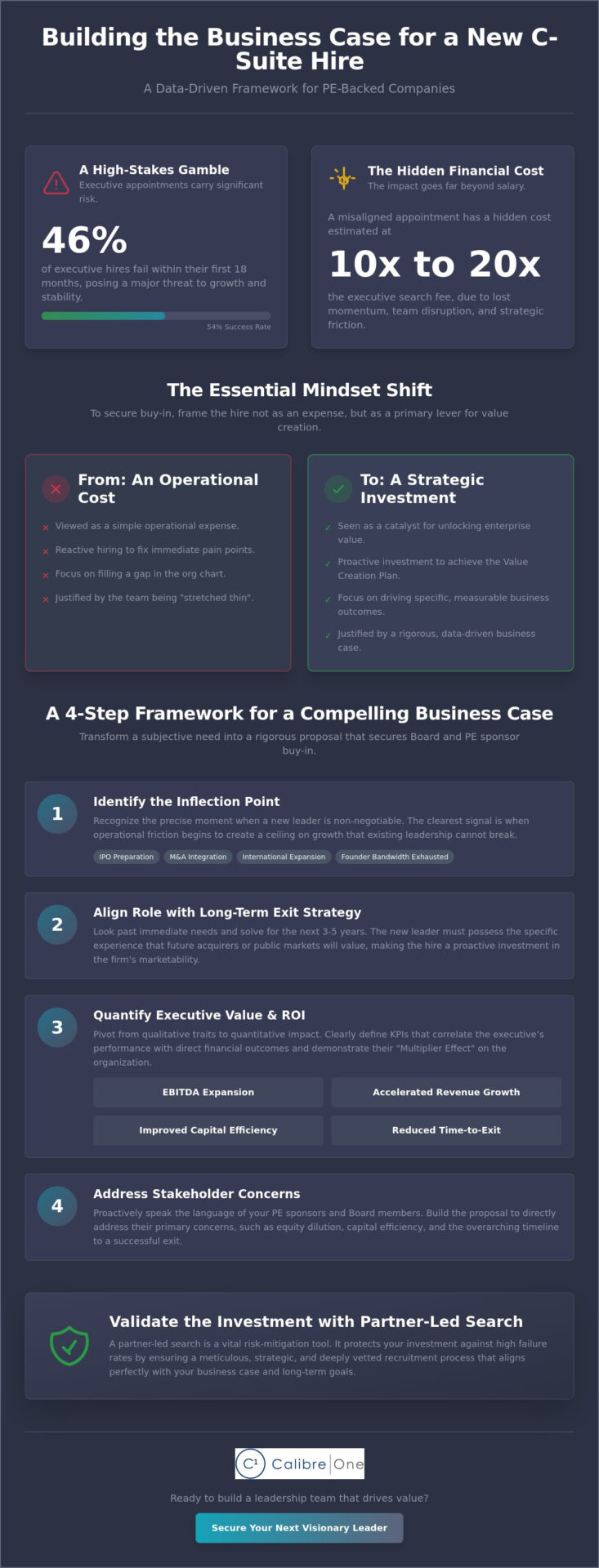
With nearly 46% of executive hires failing within their first 18 months, the decision to expand your leadership team is never just about headcount – it is a high-stakes gamble on your company’s future valuation. For tech leaders and PE partners, the challenge of building a business case for a new c-suite hire often lies in the friction between the urgent need for specialized expertise and the visceral fear of equity dilution without guaranteed results. You likely recognize that while a visionary leader can catalyze growth, a misaligned appointment carries a hidden cost often estimated at 10 to 20 times the executive search fee through lost momentum and strategic friction.
This guide provides the strategic framework necessary to transform a subjective need into a rigorous, data-driven proposal that secures Board and PE sponsor buy-in. We’ll explore how to quantify the ROI of leadership, prioritize executive roles during rapid scaling, and align every new hire with your long-term exit strategy. By following this methodology, you can present a compelling narrative that positions executive talent as a primary lever for value creation rather than a simple operational expense.
Key Takeaways
- Learn how to transition from viewing leadership as an operational cost to a strategic investment that bridges the gap between current operations and your desired exit state.
- Master the art of building a business case for a new c-suite hire by establishing clear KPIs that correlate executive performance with EBITDA expansion and revenue growth.
- Acquire strategies for aligning PE sponsors and Board members by addressing specific concerns regarding capital efficiency, equity dilution, and the overarching timeline to exit.
- Develop a structured proposal that clearly defines current organizational limitations and quantifies the financial consequences of delaying a critical leadership appointment.
- Explore why a partner-led search is a vital risk-mitigation tool, protecting your investment against the high failure rates often associated with less meticulous recruitment methods.
Table of Contents
-
The Strategic Imperative: Why a New C-Suite Role is a High-Stakes Investment
-
Quantifying Executive Value: Linking Leadership to EBITDA and ROI
-
Stakeholder Alignment: Navigating Board and PE Sponsor Expectations
-
Structuring the Proposal: A Step-by-Step Framework for the Business Case
-
The Final Component: Why Partner-Led Search Validates the Business Case
The Strategic Imperative: Why a New C-Suite Role is a High-Stakes Investment
In the context of PE-backed ventures, a new executive hire is never a mere administrative addition; it’s a deployment of significant capital aimed at unlocking specific enterprise value. Effectively building a business case for a new c-suite hire requires moving beyond the intuitive sense that the team is "stretched" and toward a rigorous business case that justifies the investment through the lens of strategic necessity. This document serves as the formal bridge between current operational constraints and the ambitious milestones outlined in your Value Creation Plan (VCP).
The transition from a founder-led "wearing many hats" culture to a specialized leadership structure is often the defining moment of a company’s scaling journey. For B2C founders, Founder Freedom provides the coaching framework necessary to navigate this evolution effectively. By 2026, the market has moved decisively away from the generalist executive. Today’s complexity demands leaders who don’t just manage teams but possess deep, niche expertise in areas like AI-driven operational efficiency or navigating the regulatory shifts seen in states like Illinois and Colorado regarding automated hiring systems. In this environment, a leader who is merely "capable" is a liability; you require a specialist who can navigate the specific headwinds of your sector while simultaneously driving the tailwinds of your innovation.
Identifying the Inflection Point for New Leadership
Recognizing the exact moment to trigger a high-stakes hire is a test of a leader’s discernment. Often, the clearest signal is when operational friction begins to outpace the team’s bandwidth, creating a ceiling on growth that no amount of effort can break. Critical milestones, such as preparing for an IPO, navigating complex M&A integrations, or executing a rapid international expansion, demand a level of specialized focus that existing leadership cannot provide without compromising core duties. The cost of inaction in these moments isn’t just a slower pace; it’s the active erosion of enterprise value as competitors move faster to capture market share. Timing is everything.
Aligning the Role with Long-Term Strategic Goals
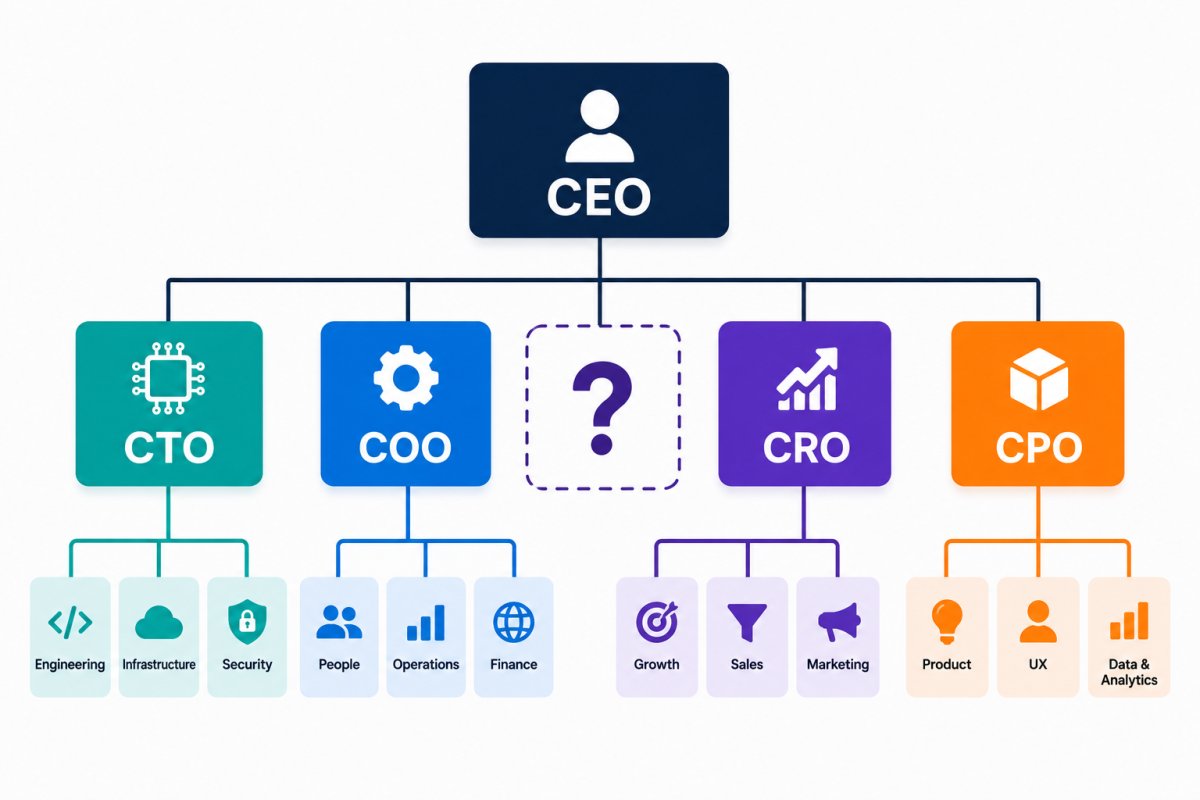
A successful business case must look past immediate pain points to solve for the complexity of the next three to five years. Every C-suite appointment should be viewed through the lens of the eventual exit strategy, ensuring the new leader possesses the specific pedigree and experience that future acquirers or public markets will value. Distinguishing between a "nice-to-have" support role and a "mission-critical" executive is essential for maintaining capital efficiency. For instance, a technology-driven firm might find that a CPO with specific experience in scaling SaaS architectures is the difference between a successful exit and a plateaued valuation. This alignment ensures that the executive search is not a reactive fix but a proactive investment in the firm’s ultimate marketability. Strategy dictates talent.
Quantifying Executive Value: Linking Leadership to EBITDA and ROI
Quantifying the impact of a leader requires a shift from qualitative traits to quantitative levers. When you’re building a business case for a new C-suite hire, the narrative must pivot toward how that individual will drive EBITDA expansion or accelerate the timeline to exit. This isn’t about filling a seat; it’s about deploying a catalyst. A high-performing executive creates a "Multiplier Effect," where their presence alone improves the output and retention of an entire department, effectively lowering the cost of talent across the organization.
The stakes of this investment are exceptionally high. Data shows that 46% of executive hires fail within 18 months, a statistic that should give any Board or PE sponsor pause. The cost of such a failure is not merely the lost salary but a total financial impact often estimated at 10 to 20 times the original search investment through lost momentum and strategic friction. To mitigate this, many leaders utilize Human Capital Due Diligence to identify specific leadership gaps and quantify their financial consequences before the search even begins.
Revenue and Growth Levers
A strategic CMO or CRO hire should be justified by their direct impact on Customer Acquisition Costs (CAC) and Lifetime Value (LTV). For tech firms, a CRO doesn’t just manage sales; they optimize the entire revenue engine to increase margin per customer. Similarly, a CTO’s value is found in their ability to reduce technical debt and implement product-led growth strategies that allow for scaling without proportional increases in headcount. By projecting the revenue lift from entering new verticals or markets, you can demonstrate exactly how the hire pays for itself within the first 12 to 24 months.
Operational Efficiency and Margin Improvement
On the efficiency side, a CFO’s role is central to optimizing capital structure and driving cost efficiencies that go straight to the bottom line. A sophisticated CFO identifies "leaky" operational processes that, when fixed, can expand margins by several hundred basis points. Likewise, a CPO streamlines the product roadmap to ensure R&D spend is focused on the highest-value features, reducing wasted development time. In the Private Equity landscape, the delta between an average executive team and an elite one is frequently reflected in a premium on exit multiples, as sophisticated buyers pay for the proven scalability and reduced risk that top-tier leadership provides.
Beyond growth and efficiency, leadership provides immense value through risk mitigation. Attributing financial value to improved compliance, cybersecurity posture, or financial governance helps round out a business case by showing how a new hire protects the existing enterprise value from unforeseen shocks. When you’re building a business case for a new c-suite hire, remember that the most persuasive arguments are those that treat leadership as a primary engine of financial performance.
Stakeholder Alignment: Navigating Board and PE Sponsor Expectations
Securing approval for a top-tier executive requires more than just a compelling spreadsheet; it requires a nuanced understanding of stakeholder psychology. When building a business case for a new C-suite hire, you’re navigating a delicate balance between the PE sponsor’s drive for capital efficiency and the founder’s emotional investment in the organization. PE partners are laser-focused on how a new executive accelerates the timeline to exit and protects the initial investment. Conversely, founders often harbor latent anxieties regarding equity dilution and the perceived loss of operational control. Bridging this gap requires a narrative that positions the new hire as a catalyst for value preservation, not just a line item on the P&L.
The formal Board vote should be the final step of a deliberate process, not the beginning. Building a consensus through informal pre-discussions allows for the airing of technical concerns in a low-stakes environment. This methodical approach ensures that by the time the proposal reaches the table, the strategic rationale is already internalized by key power brokers. Trust is the currency of these high-stakes transitions, and it’s built through transparency and the use of objective, external benchmarks.
Anticipating and Addressing Common Objections
One of the most frequent hurdles is the "Internal Promotion" argument. While promoting from within is culturally attractive, external talent becomes non-negotiable when the organization faces a "zero-to-one" challenge or requires a specific pedigree for an impending IPO. In the competitive 2026 market, justifying compensation packages requires a clear-eyed view of current data. With median total compensation for S&P 500 CEOs reaching $17.7 million in 2025, and mid-market packages for companies with revenues between $100 million and $1 billion ranging from $1.2 million to $4 million, the Board needs to understand that underpaying for a critical role is essentially a decision to accept strategic stagnation. Cultural fit, often the most elusive metric, should be addressed through rigorous behavioral assessments rather than intuitive "gut feelings."
Tailoring the Message for Different Audiences
Different stakeholders require different data sets to feel secure in their decision. The CFO needs to see a clear payback period and a granular view of the budget impact, focusing on how the hire reduces operational friction or technical debt. The Board, however, requires a focus on governance, risk management, and how the role fits into long-term succession planning. Utilizing Human Capital Due Diligence provides the objective, third-party data necessary to bypass internal biases. This data-driven approach transforms the conversation from a subjective request for headcount into a strategic proposal for organizational evolution. When you’re building a business case for a new C-suite hire, remember that clarity is the most effective tool for overcoming resistance.
Structuring the Proposal: A Step-by-Step Framework for the Business Case
A well-constructed proposal is more than a request; it is a strategic blueprint that aligns leadership needs with financial realities. When you’re building a business case for a new C-suite hire, the document must be structured to preemptively answer the Board’s most pressing questions regarding risk and return. The proposal begins with a high-level Executive Summary that focuses on the expected strategic outcome, followed by a Problem Statement that articulates the current organizational limitations and their specific financial consequences. This creates a sense of urgency by showing that the status quo is not a neutral position but a costly one.
The core of the document must define the Proposed Role with absolute clarity, outlining specific scope, responsibilities, and key performance indicators. For instance, the business case for a CTO should focus on architectural scalability and technical debt reduction, whereas a CPO hire is justified by product-market fit and roadmap acceleration. This distinction is critical; a generic "tech leader" role rarely survives the scrutiny of a PE sponsor. Finally, the Financial Impact section must present the Total Cost of Ownership (TCO) against the projected value creation. For a mid-market CEO with a total compensation package between $1.2 million and $4 million, the case must demonstrate how that investment directly catalyzes the next $50 million in enterprise value.
Defining the Ideal Candidate Profile
A successful search begins with a profile that moves beyond the resume to define the specific competencies and "soft" leadership traits required for your current growth phase. This is particularly vital for Technology-driven organizations where the ability to lead through rapid digital transformation is as important as technical pedigree. Setting realistic expectations for the search timeline is equally essential. High-stakes executive searches are methodical processes, and the hiring company should expect to invest 20 to 30 hours of leadership time in finalist interviews alone. Understanding the availability of top-tier talent in 2026 ensures the Board is aligned on the necessary patience and precision required for an elite appointment.
The Implementation and Search Strategy
The business case must also address the "how" of the search strategy. Relying on internal efforts for a C-level role often results in a limited talent pool and a higher risk of misalignment. A retained search approach, typically costing around 35% of the hire’s first-year total compensation, provides the meticulous market mapping and behavioral assessment needed to mitigate the 46% failure rate of new executives. Furthermore, the proposal should outline a robust onboarding and integration plan to ensure early "wins" and establish a feedback loop for the Board during the first 100 days. This level of intentionality proves to stakeholders that the investment is being managed with professional rigor from inception to execution.
For leaders ready to move from strategic planning to talent acquisition, viewing our portfolio of successful placements provides a benchmark for the caliber of leadership required to drive significant organizational change.
The Final Component: Why Partner-Led Search Validates the Business Case
A strategic proposal is only as robust as its execution. While building a business case for a new C-suite hire provides the financial and operational justification for investment, the search methodology itself serves as the final validation of that case. If the business case promises a specific ROI, such as margin expansion or a compressed timeline to exit, a flawed recruitment process directly jeopardizes those outcomes. The difference between "filling a seat" and intentionally building a high-performing leadership team lies in the rigor of the search partner, who must act as a bridge between your strategic vision and the reality of the talent market.
Partnering with a boutique, partner-led firm ensures that the meticulous attention required for high-stakes roles is never diluted by high-volume recruitment targets. In the elite tiers of leadership, the search is both a data-driven exercise and a delicate negotiation of alignment. A specialized partner provides the sophisticated authority needed to represent your brand to the market, ensuring that the final candidate doesn’t just possess the required competencies but also shares the intentionality of your long-term vision. This level of craftsmanship is what protects the investment established in your business case.
Boutique Focus with Global Reach
The advantages of a partner-led delivery model are particularly evident when navigating specialized sectors. Whether you are seeking leadership within Healthcare and Life Sciences or the rapidly evolving Consumer and Sports industries, you require a partner who understands the specific nuances of your vertical. This model allows for an agile, attentive approach that larger, more rigid firms often lack, providing the Board with confidence that the search process reflects their own professional standards. It is a "both/and" proposition: the deep industry expertise of a specialist combined with the global reach necessary to identify transformative talent.
Ensuring Long-Term Success through Succession Planning
Professional search should never exist in a vacuum; it must be integrated into a broader framework of Succession Planning. By positioning a new hire as part of a sustainable leadership strategy, you provide the Board and PE sponsors with the assurance that the organization is being built for resilience beyond the immediate investment cycle. This foresight transforms the act of building a business case for a new C-suite hire from a reactive necessity into a proactive masterclass in organizational evolution. Ultimately, the right search partner doesn’t just find a candidate; they secure the future of the enterprise.
Driving Enterprise Value Through Strategic Leadership
Since 1999, Calibre One has served as a strategic partner to leaders navigating these high-stakes transitions. With a global reach and a specialized focus on PE-backed technology and growth transformations, our partner-led delivery model ensures the high-touch service and meticulous attention your Board requires.
Frequently Asked Questions
How do you calculate the ROI of a new C-suite hire?
Calculating the ROI of an executive hire involves correlating their specific strategic levers with EBITDA expansion or revenue growth. For instance, a CRO’s value is measured by improvements in customer acquisition costs and lifetime value, while a CTO might be valued by the reduction of technical debt. By projecting these gains against the total cost of ownership, you transform a qualitative decision into a quantitative investment that justifies the capital deployment.
What are the most common mistakes when building a business case for an executive?
The most frequent error when building a business case for a new C-suite hire is framing the request as a need for headcount rather than a proposal for value creation. Leaders often fail to articulate the "Cost of Inaction," which leaves the Board focused on the expense rather than the potential erosion of enterprise value. A successful case must solve for future complexity, not just current operational friction, while aligning with the exit strategy.
When should a founder consider hiring a CEO or COO to step in?
A founder should consider a CEO or COO appointment when the company’s operational complexity begins to outpace their personal bandwidth or specialized expertise. This inflection point typically occurs during high-stakes milestones such as international expansion, IPO readiness, or complex M&A integrations. Bringing in a seasoned operator allows the founder to focus on visionary growth while ensuring the organizational infrastructure remains resilient, scalable, and attractive to future investors.
How much equity should be allocated for a new C-suite executive in a PE-backed firm?
Equity allocation for C-suite executives in PE-backed firms typically ranges between 2% and 5% for a CEO, with other C-level roles receiving between 0.5% and 3.0%. These figures vary significantly based on the company’s valuation and the specific stage of the investment cycle. The primary goal is to provide enough "skin in the game" to align the executive’s personal incentives with the PE sponsor’s specific timeline to exit.
Is it better to use an internal recruiter or a retained executive search firm for C-level roles?
Retained executive search is generally superior for C-level roles because it offers a level of market mapping and behavioral assessment that internal teams rarely possess. Given that 46% of executive hires fail within 18 months, the meticulousness of a partner-led search serves as a critical risk mitigation strategy. While internal recruiters excel at high-volume staffing, high-stakes leadership transitions require the specialized expertise and global reach of a boutique consultancy.
How long does it typically take to get Board approval for a new executive role?
The timeline for securing Board approval typically spans four to eight weeks, depending on the complexity of the role and the level of stakeholder alignment. This period includes the initial presentation of the business case, informal consensus building with key power brokers, and the formal vote. Providing a data-driven proposal that addresses capital efficiency and risk management can significantly compress this timeline by preemptively answering the Board’s most pressing objections.
What role does Human Capital Due Diligence play in the hiring process?
Human Capital Due Diligence acts as an objective diagnostic tool that identifies leadership gaps and quantifies their potential financial impact before a search begins. It provides the Board with a rigorous foundation for building a business case for a new C-suite hire, ensuring the appointment is strategically sound. By assessing the existing team’s capabilities, this process ensures that new hires are complementary and aligned with the overarching Value Creation Plan.
How do I handle a Board that is resistant to increasing the executive compensation budget?
When facing resistance to compensation budgets, you must shift the conversation from the cost of the hire to the cost of failure. Highlighting that a failed executive appointment can cost 10 to 20 times the original search fee through lost momentum provides a powerful counter-argument. Utilizing current market data to show that median S&P 500 CEO pay rose 5.9% in 2025 helps the Board understand that competitive compensation is a prerequisite for elite talent.