
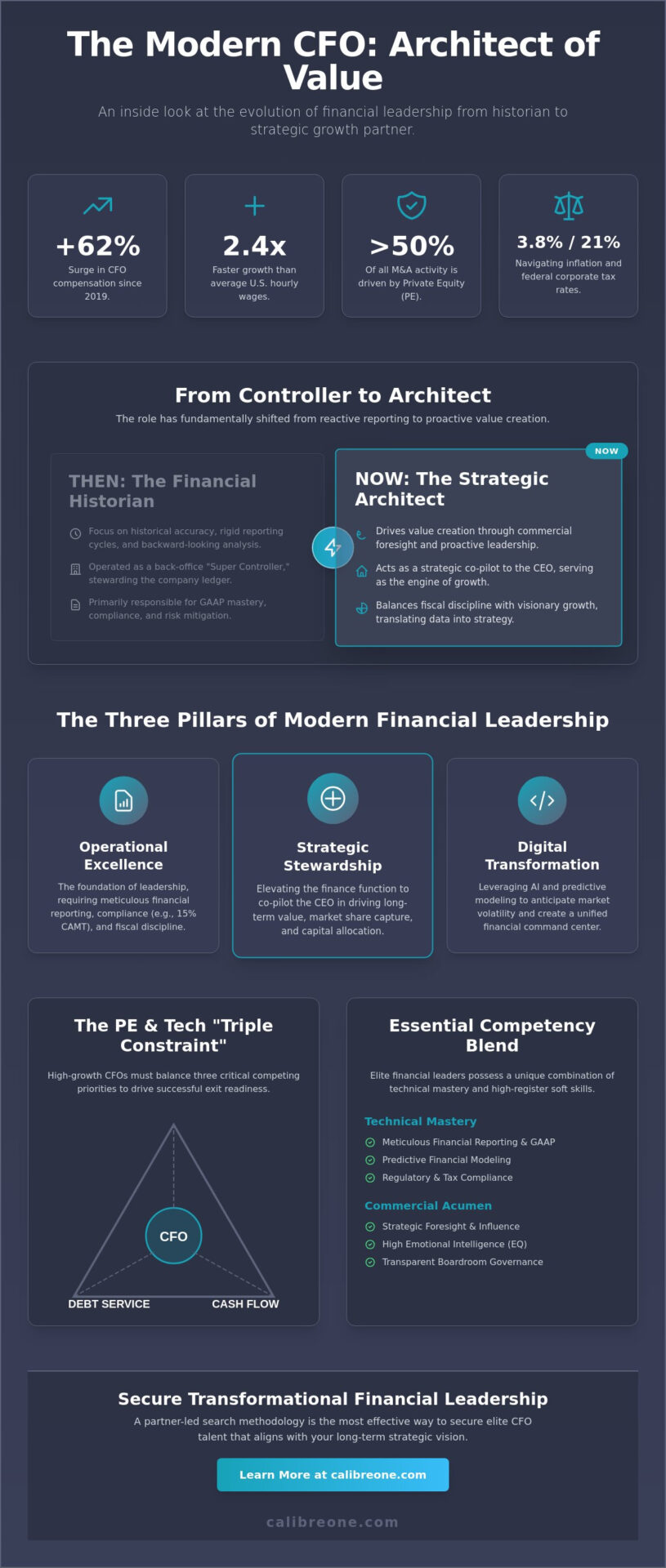
Since 2019, CFO compensation has surged by 62 percent, growing 2.4 times faster than average U.S. hourly wages. This dramatic increase reflects a fundamental shift in the mandate for financial leadership. You’ve likely recognized that the traditional role of the financial historian is no longer viable in an environment where private equity accounts for over 50 percent of all M&A activity. While technical mastery of GAAP remains a prerequisite, the modern CFO must also serve as a strategic architect of value. They must balance the precision of financial reporting with the commercial foresight required to navigate a 3.8 percent inflation rate and a 21 percent federal corporate tax landscape.
This article explores the evolution of the CFO as a visionary partner within high-growth technology and private equity ecosystems. We provide a clear framework for the modern role, demonstrating how elite financial leaders drive exit readiness through meticulous operational value creation. You will learn how to identify talent that possesses both technical mastery and the commercial acumen necessary for long-term scale. By the end of this piece, you will understand the specific attributes that define high-performing financial leadership in 2026.
Key Takeaways
- Learn how the role has transitioned from a financial historian to a strategic architect who bridges the gap between fiscal discipline and visionary growth.
- Understand the unique mandate of the private equity CFO, focusing on the speed and transparency required to drive successful exit readiness.
- Identify the essential blend of technical mastery and high-register soft skills, including emotional intelligence and influence, needed for transformational leadership.
- Gain a strategic framework for balancing the “Triple Constraint” of debt service, EBITDA growth, and cash flow within high-growth technology ecosystems.
- Explore why a partner-led search methodology is the most effective way to secure elite talent that aligns with a long-term strategic vision.
Table of Contents
-
Beyond the Balance Sheet: What is a Chief Financial Officer in 2026?
-
From Controller to Architect: The Evolution of Financial Stewardship
-
The High-Stakes CFO: Navigating Private Equity and Tech Transformation
-
Identifying Excellence: Critical Competencies for the Future-Ready CFO
-
Securing Transformational Leadership: The Calibre One CFO Search Methodology
Beyond the Balance Sheet: What is a Chief Financial Officer in 2026?
The identity of the Chief Financial Officer (CFO) has undergone a profound metamorphosis, evolving from a back-office steward of records into a primary architect of organizational health. In 2026, this role is no longer confined to the narrow margins of the balance sheet; it’s a position that demands both the technical precision of a master accountant and the commercial foresight of a seasoned strategist. The shift from a financial historian to a value catalyst represents a move toward proactive leadership, where the finance function serves as the engine of growth rather than a mere mirror of past performance.
Defining this mandate requires a bridge between two worlds. The modern CFO is a strategic partner who translates financial data into actionable commercial strategy. This leadership ensures that capital allocation is never a static exercise but a dynamic tool for capturing market share, especially as businesses navigate a 3.8 percent annual inflation rate and the complexities of a 21 percent flat federal corporate tax rate.
The Three Pillars of Modern Financial Leadership
Effective leadership in financial services and high-growth sectors rests upon three distinct yet integrated pillars. Operational excellence remains the foundation, requiring a meticulous approach to financial reporting and compliance with regulations such as the 15 percent Corporate Alternative Minimum Tax (CAMT). Strategic stewardship then elevates this foundation, positioning the finance leader as a co-pilot to the CEO in driving long-term value creation. Finally, digital transformation has become non-negotiable, as AI moves mobile banking and treasury management toward a unified financial command center. This technological shift allows for predictive modeling that anticipates market volatility before it manifests on the ledger.
Reporting Lines and Board Interaction
The reporting structure of the modern finance office reflects its dual nature, maintaining a direct line to the CEO while serving as a critical advisor to the Board of Directors. This relationship is built on a foundation of transparency and intellectual honesty, particularly when managing the expectations of the Audit Committee. The finance leader acts as the primary conduit for boardroom governance, ensuring that every strategic pivot is backed by rigorous data. In an era where non-financial misconduct rules and new AML/CFT requirements are coming into scope, the ability to manage these high-stakes relationships with quiet confidence is what separates elite talent from the status quo.
From Controller to Architect: The Evolution of Financial Stewardship
The 1990s archetype of the financial leader was defined by the "Super Controller." This individual focused almost exclusively on the accuracy of the ledger and the rigidity of reporting cycles. However, the subsequent decades brought a series of systemic shocks that fundamentally altered this requirement. The 2008 financial crisis demanded a new focus on liquidity and capital preservation, while the 2020 pandemic necessitated a level of agility that traditional reporting simply could not support. Today, the role has moved from the back office to the center of the enterprise, where the CFO acts as a primary architect of growth.
In 2026, the mandate is no longer about looking backward. It’s about real-time, predictive business intelligence. With GDP growth forecasts for the year hovering between 1.8 percent (Indiana Business Research Center) and 2.6 percent (Goldman Sachs), there’s little room for error. Leadership now requires the ability to synthesize complex data into a narrative that guides the CEO through economic volatility. Securing this level of versatility requires a specialized approach to CFO Search that prioritizes commercial depth over mere technical compliance.
The Death of the "Bean Counter" Stereotype
Technical accounting skills, while essential, are now considered the baseline rather than a competitive differentiator. The true edge in modern leadership is commercial acumen. The modern "Commercial CFO" possesses a deep understanding of the product and the customer journey, bridging the gap between back-office data and front-line execution. They don’t just report on sales; they understand the drivers of customer lifetime value and the nuances of the competitive landscape. This shift ensures that financial strategy is always aligned with the practical realities of the market.
The CFO as the Chief Transformation Officer
Beyond traditional stewardship, the role has expanded to sometimes include the responsibilities of a chief transformation officer. This involves leading organizational change through financial restructuring and managing complex M&A activity, which accounts for more than half of all deal volume in the private equity space. By driving digital adoption to automate transactional finance functions, the leader frees up capital and human resources for strategic investment. They must balance the necessary discipline of cost-cutting with the vision required to fund innovation, ensuring the business remains both lean and forward-thinking.
The High-Stakes CFO: Navigating Private Equity and Tech Transformation
In the high-velocity sectors of technology and private equity, the margin for error is non-existent. The mandate for a CFO in these environments is defined by three relentless variables: speed, transparency, and an unwavering focus on exit readiness. Unlike traditional corporate roles, the PE-backed finance leader operates within a compressed timeframe where every decision is a lever for valuation. This requires a professional who can maintain the composure of a seasoned steward while executing with the urgency of a founder.
Managing the "Triple Constraint" requires a delicate balance between servicing debt, driving EBITDA growth, and maintaining robust cash flow. With the federal funds rate recorded at 3.75 percent in April 2026, the cost of capital remains a primary consideration for leveraged portfolios. The leader must navigate these pressures while accounting for the 15 percent Corporate Alternative Minimum Tax (CAMT) and a flat 21 percent federal corporate tax rate, ensuring that fiscal discipline never stifles the agility required for hyper-growth. This transition from Series C to an IPO or major liquidity event represents a fundamental shift in leadership, moving from "scrappy" execution to the rigorous, public-market-ready standards of a mature organization.
Value Creation in Private Equity
The first 100 days of a private equity investment are critical for setting the trajectory of the asset. The finance leader must work in close alignment with Operating Partners to execute a meticulous value creation plan. This involves several key actions:
-
Developing sophisticated, real-time reporting packages that satisfy the granular demands of PE investors.
-
Driving operational leverage by identifying inefficiencies that traditional controllership might overlook.
-
Focusing on margin expansion through disciplined cost management, ensuring every dollar of revenue contributes to the bottom line.
-
Leveraging data analytics to provide predictive insights that guide the CEO through shifting market dynamics.
Exit Readiness and M&A Strategy
Preparing an organization for a successful liquidity event requires a level of precision that begins years before the actual transaction. The finance leader manages the due diligence process with quiet authority, ensuring that the books are not just accurate, but beyond reproach. This meticulous preparation prevents valuation leakage during the high-stakes scrutiny of a sale. Additionally, as private equity continues to account for more than half of all M&A activity, the ability to integrate acquisitions effectively is vital. The leader must ensure that new assets align both financially and culturally, capturing the intended synergies without disrupting the core business’s momentum. As these M&A activities drive significant personal liquidity for stakeholders, many look to Neil Jesani Wealth for institutional-grade wealth management that aligns with their professional financial standards.
Identifying Excellence: Critical Competencies for the Future-Ready CFO
While technical credentials provide the baseline for entry, they rarely distinguish the elite performer from the competent administrator. A sophisticated cfo must certainly possess a forensic understanding of GAAP and IFRS, particularly as they manage the implications of the 21 percent federal corporate tax rate and the 15 percent Corporate Alternative Minimum Tax (CAMT). However, technical mastery is merely the foundation upon which strategic leadership is built. The modern mandate requires a leader who can anticipate market shifts before they appear in the quarterly reporting, utilizing predictive intelligence to see around corners in a volatile economic climate where annual inflation reached 3.8 percent in April 2026.
Soft skills have transitioned from elective traits to hard assets. The ability to influence the C-suite and communicate high-stakes financial trade-offs with clarity is essential for driving organizational alignment. The elite CFO possesses the balanced contrast of forensic detail and broad strategic vision. This duality allows them to maintain meticulous control over the ledger while simultaneously serving as a visionary partner to the CEO. Identifying this specific blend of attributes is a core component of our CFO Search methodology, where we look beyond the resume to find individuals who can lead through complexity.
The Commercial Mindset
Excellence in 2026 is defined by a deep understanding of unit economics that extends far beyond the traditional P&L. A future-ready leader collaborates with GTM teams to optimize pricing strategies and customer acquisition costs, ensuring that every marketing dollar is an investment in scalable growth. They evaluate R&D expenditures not just as a current-period cost, but through the lens of long-term ROI and intellectual property value. This commercial depth—which often includes leveraging vendor credit terms through The CEO Creative to build business credit—ensures that the finance function isn’t a bottleneck to innovation but a catalyst for profitable expansion.
Leadership and Team Building
The role of the finance leader is also one of a cultural steward and a talent magnet. Building a modern finance team requires the ability to attract top-tier professionals who value both technical precision and strategic impact. This involves active mentoring and rigorous succession planning, ensuring the organization remains resilient during leadership transitions. By acting as a peer to other C-suite executives, the finance leader helps shape the broader organizational culture, fostering a sense of accountability and intentionality that permeates every department.
Securing Transformational Leadership: CFO Search Methodology
Traditional recruitment often prioritizes volume over nuance, treating the search for a CFO as a transactional exercise in matching credentials rather than a strategic alignment of vision. This approach fails to account for the specific pressures of 2026, where a leader must navigate a 3.8 percent inflation rate and a 21 percent corporate tax landscape while driving enterprise value. Where you run a search it is important that the process is designed to identify the elite, "passive" talent that standard headhunters often overlook, finding leaders who are currently driving value in high-stakes environments rather than those actively seeking their next role.
Architecting the Future of Financial Leadership
The constant evolution of the finance office is critical in a volatile global market. We have explored how the modern leader must serve as both a meticulous steward of records and a visionary architect of value. This synthesis of forensic detail and strategic foresight is particularly vital within private equity and technology sectors, where the path to a successful exit depends on operational value creation and absolute fiscal transparency. While the technical foundations of the role remain non-negotiable, it is the integration of commercial acumen and emotional intelligence that separates the elite practitioner from the traditional controller.
Frequently Asked Questions
What is the primary difference between a CFO and a Controller?
The distinction lies in the temporal focus and strategic depth of their responsibilities. A Controller manages the historical integrity of the ledger and ensures compliance with current regulations, such as the 15 percent Corporate Alternative Minimum Tax. In contrast, the CFO acts as a strategic architect who uses that financial data to forecast future performance and guide capital allocation. One oversees the recording of value, while the other drives its proactive creation.
Does a CFO need to be a CPA or have an MBA?
While these credentials aren’t strictly mandatory for every organization, they provide a vital foundation for technical and commercial excellence. A CPA ensures a deep mastery of GAAP and IFRS, which is essential for managing a 21 percent federal corporate tax rate. An MBA often signals the commercial breadth required to partner with the CEO on strategic initiatives. Elite candidates often possess both to demonstrate a balance of forensic detail and broad vision.
What is the role of a CFO in a Private Equity exit?
The finance leader is the primary guardian of valuation during a liquidity event or IPO. They ensure absolute exit readiness by maintaining meticulous records and managing the due diligence process with quiet authority. By identifying and mitigating potential financial risks before they arise, the leader prevents valuation leakage. Their role is to present a clean, growth-oriented narrative to potential buyers or public market investors that justifies a premium valuation.
When should a high-growth startup hire its first CFO?
High-growth startups typically require a full-time finance leader during the transition from Series B to Series C, or when the complexity of capital allocation outstrips the capacity of a fractional provider. This is the point where the business moves from "scrappy" execution to requiring rigorous, institutional-grade financial structures. Hiring early ensures that the organization is built on a foundation of scalability and is prepared for the scrutiny of later-stage investors or a potential IPO.
What are the most important interview questions for a CFO candidate?
Effective interview questions should move beyond technical proficiency to probe for strategic depth and commercial acumen. Inquire about how they have executed a 100-day value creation plan or how they balanced cost-cutting with innovation during periods of 3.8 percent inflation. Ask for specific examples of how they translated complex financial data into a commercial strategy that directly impacted EBITDA. Their ability to articulate these narratives reveals their potential as a strategic partner.
How is AI changing the role of the Chief Financial Officer?
Artificial intelligence is transforming the finance office into a real-time command center by automating transactional functions and enabling predictive modeling. This shift allows the CFO to move away from retrospective reporting and toward providing proactive business intelligence. AI-driven tools now handle fraud detection and personalized customer experiences, freeing the finance team to focus on high-level strategic stewardship. It effectively turns data into a competitive asset rather than a storage requirement.
Why should we use an executive search firm for a CFO role instead of internal HR?
Executive search firms provide access to the elite, "passive" talent pools that internal HR departments and standard headhunters often overlook. These firms operate as discerning strategic partners, utilizing a peer-to-peer vetting process to ensure both technical mastery and cultural alignment. Given that private equity accounts for more than half of all M&A activity, specialized firms bring the specific expertise required to identify leaders who can navigate the unique pressures of PE-backed transformation and exit strategy.