
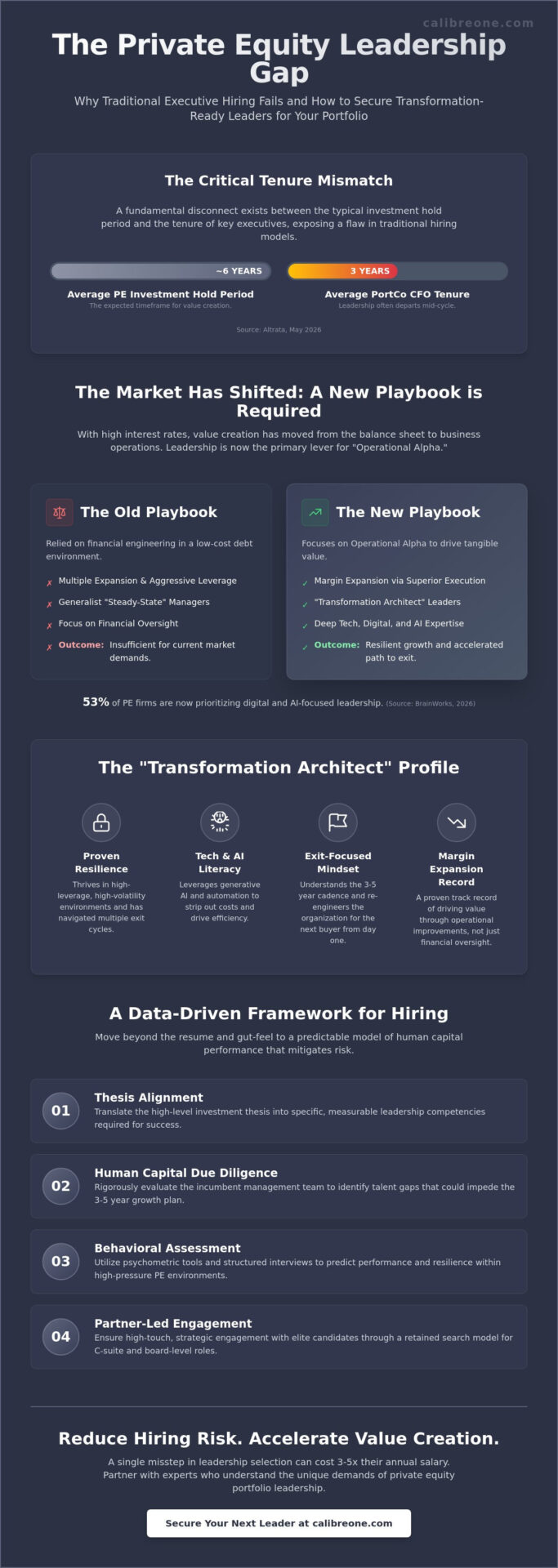
Why does the average CFO in a private equity portfolio company last only three years when the typical investment holding period extends to nearly six? This tenure gap, identified by Altrata in May 2026, reveals a fundamental flaw in traditional PE portfolio company executive hiring: the disconnect between a candidate’s past corporate prestige and their future ability to drive operational alpha. You recognize that the shift from founder-led agility to private equity rigor is a delicate evolution where value is either captured or lost. It’s no longer sufficient to secure a steady hand for oversight; you require transformation architects capable of executing a complex thesis under volatile conditions.
Discover how to identify and recruit leaders who possess both the technical literacy to leverage generative AI and the strategic depth to align with your long-term growth objectives. This guide offers a methodical approach to reducing hiring risk and accelerating your path to value creation. We’ll examine the specific leadership profiles required to scale toward an exit, ensuring your human capital due diligence is as rigorous as your financial analysis.
Key Takeaways
- Transition from financial engineering to operational alpha to meet the demand for the 53% of firms prioritizing digital and AI-focused leadership in 2026 (BrainWorks).
- Implement a rigorous framework for PE portfolio company executive hiring that aligns every search mandate with your specific 3-5 year investment thesis.
- Evaluate the “Value Creation” profile by prioritizing candidates with proven resilience and a track record of driving margin expansion in high-leverage environments.
- Accelerate the path to exit by integrating human capital due diligence with a structured approach to the first 100 days of executive performance.
- Discern the strategic advantages of a partner-led retained search model over traditional networks when recruiting for specialized C-suite and board-level roles.
Table of Contents
-
The Shifting Landscape of PE Portfolio Company Executive Hiring
-
A Data-Driven Framework for Identifying Transformation Leaders
-
Integrating Leadership Development into the Hiring Lifecycle
The Shifting Landscape of PE Portfolio Company Executive Hiring
The 2026 private equity environment is defined by a rigorous focus on the bottom line. With interest rates remaining elevated, private equity firms can no longer rely on multiple expansion or aggressive leverage to secure returns. This macroeconomic shift has fundamentally altered the requirements for PE portfolio company executive hiring, moving the focus away from generalist managers toward specialized operators who can extract value through efficiency. A single misstep in leadership selection carries a heavy price; industry estimates suggest the true cost of a bad executive hire ranges from three to five times their annual salary, once lost momentum and cultural disruption are factored in.
From Financial Engineering to Operational Alpha
In a market where cheap debt is a relic of the past, value creation has migrated from the balance sheet to the front lines of business operations. Leadership is now the primary lever for what GPs call "operational alpha," the ability to drive margin expansion through superior execution. While previous cycles prioritized financial oversight, the current landscape demands executives who bring deep technology expertise into traditional industries. This cross-pollination allows legacy businesses to implement AI and automation, stripping out costs that were previously considered fixed and creating a more attractive profile for future acquisition.
The Scarcity of Transformation Architects
The "steady-state manager" who excels in a predictable corporate environment is often ill-equipped for the volatility of a PE-backed venture. Instead, the market demands "transformation architects," leaders who have navigated multiple exit cycles and understand the intense cadence of a 3-5 year investment thesis. These individuals are rare and highly sought after, leading to the rise of the Operating Partner role as a central figure in talent selection. These partners work alongside search firms to conduct deep human capital due diligence, ensuring that a candidate’s past successes are repeatable in a high-leverage context. The goal is to find a leader who doesn’t just manage the status quo but actively re-engineers the organization for the next owner’s scrutiny from day one.
A Data-Driven Framework for Identifying Transformation Leaders
Traditional recruitment often relies on the strength of a resume; however, successful PE portfolio company executive hiring depends on the rigor of a due diligence exercise. Treating talent as a measurable asset class requires A Data-Driven Framework that validates a candidate’s ability to perform under the specific stresses of a private equity hold period. This methodical approach ensures that every placement is a strategic match for the investment’s lifecycle, rather than a mere administrative fill. By quantifying leadership traits, firms can move beyond gut feeling to a more predictable model of human capital performance.
-
Step 1: Thesis Alignment. Translate the high-level investment thesis into specific, measurable leadership competencies.
-
Step 2: Human Capital Due Diligence. Evaluate the incumbent management team to identify gaps that could impede the 3-5 year growth plan.
-
Step 3: Behavioral Assessment. Utilize psychometric tools to predict performance and resilience within high-leverage environments.
-
Step 4: Partner-Led Engagement. Ensure high-touch interaction with elite candidates through a process led by experienced search partners.
-
Step 5: Exit Readiness Validation. Finalize selection based on a candidate’s proven ability to build a business with the next buyer’s due diligence in mind.
By shifting the focus from "who we know" to "what the thesis requires," firms can significantly reduce the risk of executive turnover. If you’re looking to refine your leadership bench, a specialized Human Capital Due Diligence assessment can provide the clarity needed to make informed decisions before the first 100 days conclude.
Aligning the Mandate with the Investment Thesis
A buy-and-build strategy demands a vastly different leadership profile than a pure cost-cutting play. The Board must play an active role in defining success metrics that go beyond quarterly EBITDA targets, focusing instead on long-term scalability. Mandate Alignment is the precise synchronization of executive competencies with the specific internal rate of return (IRR) goals established at entry. It’s about finding the leader who can both manage the complexity of rapid M&A and maintain the nuance of cultural integration during a period of high-speed growth.
Human Capital Due Diligence (HCDD)
HCDD is as critical to the investment’s success as financial or legal audits, yet it’s often the most overlooked component of the deal cycle. Effective HCDD identifies "hidden" leadership gaps that may not surface until the company is under the intense pressure of PE ownership. By analyzing the existing team’s capabilities across varied sectors and industries, firms can proactively address succession needs. This process ensures that the leadership team isn’t just capable of managing the current state, but is fully equipped to scale the organization toward a successful exit from day one.
Beyond the Resume: The "Value Creation" Executive Profile
Identifying the right leader requires looking past the prestige of a blue-chip pedigree. In the high-stakes environment of private equity, a candidate’s historical success in a stable corporate setting doesn’t always translate to performance under the pressure of a leveraged balance sheet. Effective PE portfolio company executive hiring focuses on a specific "Value Creation" profile, prioritizing individuals who possess the rare combination of strategic foresight and a hands-on, operational grit. These leaders don’t just manage a business; they re-engineer it with a constant focus on the eventual exit valuation.
-
Resilience: The emotional and professional capacity to thrive in high-leverage environments where accountability is absolute and the margin for error is slim.
-
Capital Efficiency: A disciplined approach to resource allocation, favoring lean operations and high-impact investments over bloated corporate structures.
-
Agility: The ability to make high-velocity decisions in volatile market conditions without sacrificing long-term strategic integrity.
-
Exit Orientation: A mindset that views every operational improvement through the lens of the next buyer’s due diligence, ensuring the business is always "sale-ready."
The "PE-Fit" Behavioral Competency Map
The distinction between a traditional corporate executive and a PE-ready leader often comes down to the cadence of their work. While a corporate C-suite might prioritize consensus and steady incrementalism, a PE-backed leader must embody radical transparency and extreme urgency. Data from Altrata in May 2026 suggests that while the average CEO tenure aligns with the hold period at 5.8 years, COOs and CFOs see significantly shorter tenures of 3.7 and 3 years, respectively. This churn often stems from a lack of "PE-fit," specifically a failure to adapt to the data-fluency requirements of modern firms. Success in these roles requires a leader who can bridge the gap between high-level vision and the granular data needed to satisfy board-level scrutiny.
Sector Specialization: From Healthcare to Industrials
DNA that thrives in a SaaS environment rarely translates perfectly to the regulatory complexities of Healthcare and Life Sciences. In these sectors, leadership requires a nuanced understanding of compliance and clinical pathways that generalist operators often lack. Altrata’s May 2026 research highlights this necessity, noting that 87% of C-suite leaders in PE-owned pharmaceutical and biotech firms were hired directly from within that sector. Similarly, driving a transformation in Advanced Industrials requires a leader who can integrate technology into legacy manufacturing processes without disrupting core output. Each sector demands a bespoke search strategy that prioritizes specific regulatory and operational expertise over general management experience.
Integrating Leadership Development into the Hiring Lifecycle
Successful PE portfolio company executive hiring doesn’t conclude with a signed offer letter. In the high-velocity environment of private equity, the transition from candidate to high-performer is where the most significant value is often secured or lost. While the initial search ensures a match on paper, leadership development ensures a match in practice. You shouldn’t view professional development as a luxury for the mid-market; it’s a strategic tool used to mitigate the risk of early turnover and to foster a culture of continuous improvement that appeals to future acquirers. Hiring is the acquisition of potential, but development is the realization of value.
For those looking to expand their network and expertise, entrepreneurs and real estate investors can visit The Boardroom Mastermind to join an elite peer group and educational platform.
The First 100 Days: Onboarding for Impact
The first 100 days are critical for establishing credibility and momentum within a new portfolio company. During this period, the PE Operating Partner acts as a bridge, aligning the new executive’s tactical actions with the board’s strategic expectations. Without a structured onboarding process, nearly 40% of new senior executives fail within their first 18 months, a statistic frequently cited in leadership research from Harvard Business Review. By defining "Quick Win" objectives early, firms can build the executive’s confidence and demonstrate immediate progress toward the investment thesis. This high-touch integration period transforms a talented individual into a cohesive part of the investment strategy.
Building a Leadership Pipeline for Exit
A robust leadership pipeline is a tangible asset during the exit process. Prospective buyers look for businesses that aren’t dependent on a single charismatic leader but instead possess a deep bench of talent. Training the "N-1" layer of management ensures that the company remains stable post-transaction, which can directly impact the final valuation multiple. Investing in the professional growth of the broader management team also drives executive NPS scores higher, fostering the loyalty needed to see a long-term hold through to completion. This focus on continuity demonstrates that the business is built for sustained growth rather than temporary gains.
Preparing your leadership team for the scrutiny of a future sale requires a forward-looking strategy that begins long before the exit process. To ensure your organization is positioned for maximum valuation, consider how a structured approach to Succession Planning can strengthen your management bench and reduce investment risk.
Scaling Portfolio Success with a Retained Search Partner
The final phase of a successful investment cycle begins with a commitment to elite talent acquisition. While many transactional platforms offer access to vast databases, the complexity of PE portfolio company executive hiring requires a more nuanced approach than a simple search-and-fill model. A retained search partner doesn’t just provide candidates; they act as a strategic extension of the private equity firm’s brand, ensuring that the initial interaction with a high-stakes hire reflects the professionalism and vision of the GPs. This partnership model delivers long-term ROI by aligning leadership selection with the fundamental mechanics of the investment thesis. It’s a process defined by intentionality rather than volume.
Boutique Focus with Global Reach
In the current talent market, the most effective searches are those that combine the agility of a boutique firm with the expansive reach of a global powerhouse. Elite candidates in technology-driven sectors expect a high-touch, personalized experience that a high-volume recruitment platform cannot replicate. Calibre One’s heritage in technology leadership provides a deep understanding of how digital transformation drives value across all industries, from healthcare to advanced industrials. By maintaining a specialized focus, a search partner can navigate the scarcity of "transformation architects" with a level of precision that ensures both a cultural and strategic fit. This dual capability allows for the meticulous attention of a specialist while leveraging a network that spans major global markets.
The Strategic Advisor vs. The Recruiter
A true partner moves beyond the administrative task of filling a role to provide comprehensive advisory services on organizational design. This shift involves providing real-time market intelligence and salary benchmarking that reflects the competitive landscape of 2026. Rather than reacting to a vacancy, a strategic advisor helps the board anticipate future needs through Succession Planning and human capital due diligence. This ensures that the leadership bench is built not just for the current quarter, but for the eventual exit. This advisory-led approach transforms recruitment from a cost center into a primary driver of operational alpha.
Building a C-suite team capable of driving significant growth requires more than a database; it requires a discerning partner who understands the nuances of your investment strategy.
Beyond leadership, ensuring your operations meet international benchmarks is vital; Align Quality provides the expertise needed to achieve quality management certification, enhancing the overall value and exit readiness of the portfolio company.
Securing the Future of Your Portfolio Leadership
As the 2026 investment landscape continues to prioritize operational excellence, the ability to identify and integrate the right leadership becomes your most significant competitive advantage. We’ve explored how a shift toward operational alpha and the rigorous application of human capital due diligence can mitigate the risks associated with high executive turnover. Mastering PE portfolio company executive hiring is no longer a back-office function; it’s a core component of the investment thesis itself. Success requires a balance between a candidate’s past performance and their future agility within high-leverage environments.
Frequently Asked Questions
What is the average timeline for a PE portfolio company executive search in 2026?
The average time-to-fill for senior C-suite roles in 2026 is between 90 and 120 days. This duration reflects the meticulous nature of PE portfolio company executive hiring, where finding a match for the investment thesis takes precedence over speed. While junior roles might be filled in under 72 hours during compressed cycles, the complexity of a CEO or CFO search requires a methodical, multi-stage evaluation to ensure long-term alignment.
How does human capital due diligence differ from standard background checks?
Human capital due diligence is a strategic assessment of a leadership team’s ability to execute a specific investment thesis, whereas standard background checks focus on historical verification. This process evaluates behavioral competencies, data-fluency, and cultural fit through a lens of future value creation. It identifies potential leadership gaps early in the deal cycle, allowing GPs to address succession or development needs before they impact the internal rate of return.
Why do many corporate executives fail when transitioning to private equity-backed roles?
Corporate executives often struggle in private equity due to the lack of extensive support structures and the requirement for immediate, high-stakes decision-making. The transition from a consensus-driven environment to one defined by high leverage and absolute accountability can be jarring. Success in PE portfolio company executive hiring depends on finding transformation architects who thrive in volatility rather than steady-state managers who rely on established corporate inertia.
What are the most in-demand C-suite roles for PE portfolio companies today?
Demand is currently surging for Chief Revenue Officers and Chief Growth Officers as firms prioritize top-line expansion over simple cost-cutting. According to BrainWorks in January 2026, 53% of private equity firms also expect to increase hiring for roles focused on digital transformation and AI. This shift reflects a move away from purely financial oversight toward a need for leaders who can drive operational alpha through technology and market capture. The shift to AI, unsurprisingly, is a prevalent theme currently. >50% of our current work has a significant AI component to it.
How can PE firms improve executive retention during a 5-year hold period?
Retention is best improved by integrating leadership development and clear success metrics into the first 100 days of an executive’s tenure. Establishing clear "Quick Win" objectives and providing access to specialized coaching creates a sense of shared purpose and momentum. When leaders feel supported by the PE Operating Partner and see a clear path to value creation, they’re more likely to remain committed throughout the typical five-year hold period.
What role does technology expertise play in non-tech PE portfolio hiring?
Technology and AI literacy is now a mandatory requirement for all C-suite leaders, regardless of the sector. With generative AI adoption reaching 60% across portfolio companies according to Pitchbook data from January 2026, leaders must understand how to implement automation to reduce legacy costs. This expertise allows non-tech businesses to achieve higher margins and presents a more sophisticated data strategy to potential buyers during the exit process.
Should we use a specialized boutique search firm or a large global firm for our CEO search?
The ideal choice is a firm that provides a partner-led delivery model, offering the high-touch engagement of a boutique with the network of a global powerhouse. While large firms offer scale, they often lack the sector-specific focus required for complex transformations. A specialized partner acts as an extension of the PE firm’s brand, ensuring that the candidate experience is sophisticated and aligned with the exclusivity of the role.
How does leadership development impact the final exit valuation of a portfolio company?
A robust leadership pipeline significantly increases a company’s attractiveness to future buyers by ensuring continuity post-exit. When a portfolio company demonstrates a deep bench of talent at the layer below the C-suite, it reduces the perceived risk of the transaction. This stability often leads to higher valuation multiples, as the buyer is acquiring a sustainable organizational engine rather than a business dependent on a few key individuals.