
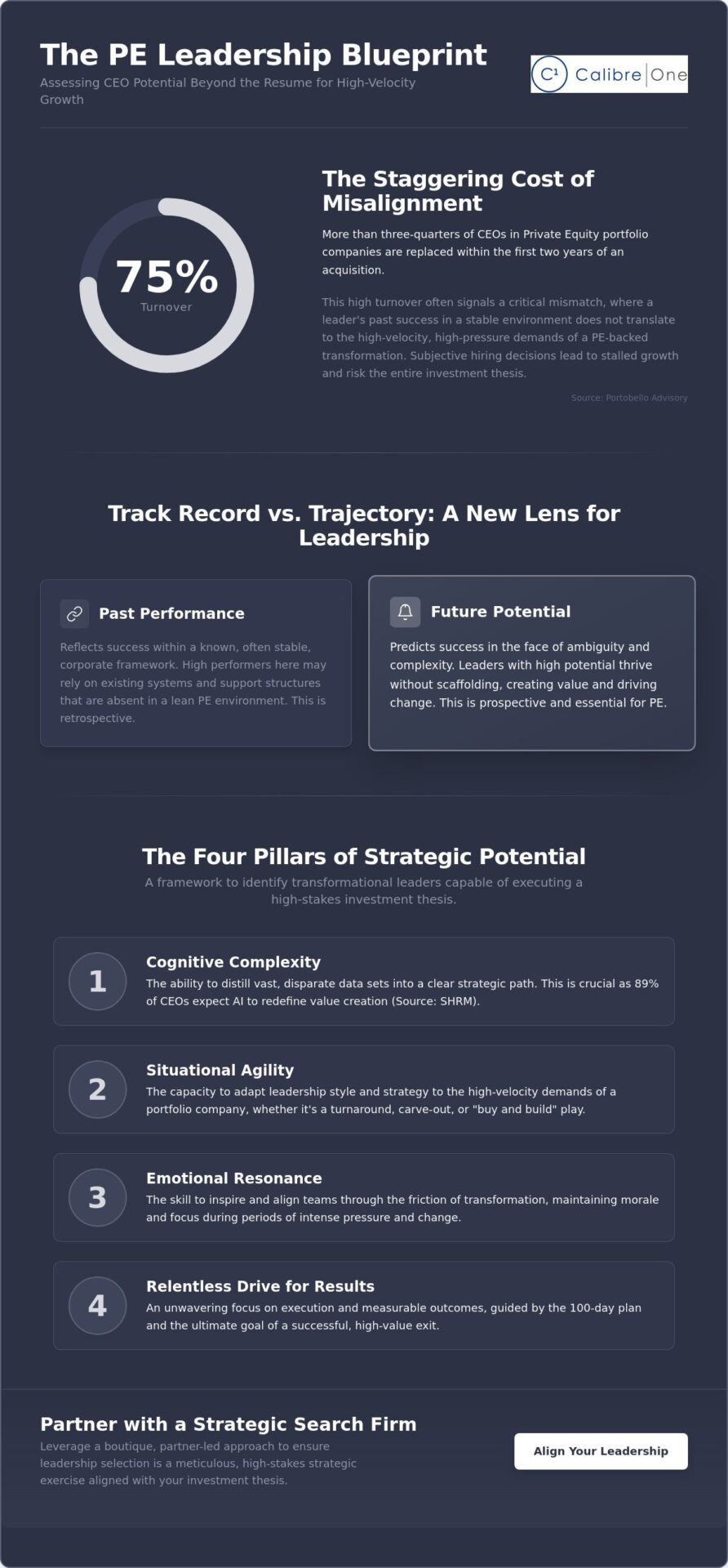
More than 75% of CEOs in Private Equity portfolio companies are replaced within the first two years of an acquisition, according to Portobello Advisory (February 19, 2026). This staggering turnover rate often stems from a fundamental misalignment between a candidate’s historical success and the high-velocity requirements of a PE environment. Understanding how to assess CEO leadership potential requires more than a cursory review of past achievements; it demands a sophisticated analysis of a leader’s ability to drive value creation while navigating the inevitable friction of organizational transformation. You likely recognize that subjective hiring decisions lead to cultural misalignment and, ultimately, stalled growth.
In this article, we provide a precise methodology for identifying transformational CEO talent capable of driving exit readiness. We’ll examine a repeatable framework that reduces selection risk by prioritizing cognitive complexity and AI acumen, which 89% of CEOs now believe will redefine how companies capture value (SHRM, June 17, 2026). By moving beyond the surface of a polished resume to evaluate situational alignment, you can ensure your leadership talent is as disciplined and strategic as the investment thesis itself.
Key Takeaways
- Learn how to assess CEO leadership potential by moving beyond historical titles to evaluate a candidate’s capacity for managing the extreme complexity inherent in PE transformations.
- Identify the “context trap” where past performance at larger organizations might mask a lack of the situational agility needed for the high-velocity demands of a portfolio company.
- Explore the four pillars of strategic potential, focusing on cognitive complexity and the ability to find clear strategic paths through disparate data sets.
- Adopt a rigorous human capital due diligence framework that utilizes behavioral interviews and cognitive testing to align talent with your specific investment thesis.
- Leverage a boutique, partner-led approach to CEO search to ensure that leadership selection is treated as a meticulous, high-stakes strategic exercise.
Table of Contents
-
Beyond the Resume: Defining CEO Leadership Potential in 2026
-
Track Record vs. Trajectory: Why Past Success Does Not Guarantee PE Growth
Beyond the Resume: Defining CEO Leadership Potential in 2026
In the high-stakes environment of Private Equity, the definition of leadership is undergoing a fundamental shift. While a resume provides a historical record of what has been accomplished, it rarely illuminates what can be achieved under the pressure of a rapid transformation. To understand how to assess CEO leadership potential in 2026, investors must look beyond traditional metrics like tenure or specific titles, as these markers are increasingly disconnected from the ability to manage extreme complexity and ambiguity. A leader may possess the technical precision of an operator, yet lack the visionary breadth required for a global carve-out.
Potential is not a static quality; rather, it is the latent capacity to handle increased scale and navigate the volatile intersections of technology and market shifts. We prioritize "Value Creation Velocity," a metric that evaluates how quickly a leader can translate strategic intent into bottom-line impact. This evolution from experience-based hiring to potential-based selection is essential for PE portfolio growth, especially when 89% of CEOs expect AI to redefine value creation (SHRM, June 17, 2026). In a market where 75% of CEOs are replaced within two years (Portobello Advisory, February 19, 2026), the cost of misjudging this velocity is simply too high to ignore.
This video, from one of our esteemed competitors, is worth a view:
The Difference Between Performance and Potential
Performance is retrospective, reflecting success within a known framework. Potential is prospective, rooted in foundational leadership theories that emphasize adaptability and cognitive agility. High performers often stumble when the scaffolding of their previous organization is removed, revealing a lack of the inherent potential required to scale. It’s a common trap: assuming a leader who thrived in a stable environment can replicate that success in a high-pressure PE setting. True potential manifests as the ability to thrive in the absence of established systems, creating order where there was once only ambiguity.
Why PE Leadership Requires a Different Lens
PE environments demand a unique marriage of operational discipline and strategic fluidity. Assessment must be tethered to the investment thesis, ensuring that a leader’s latent strengths align with the specific goals of the fund. Whether the path involves a distressed turnaround or an aggressive "buy and build" strategy, Human Capital Due Diligence serves as a foundational step. This meticulous process ensures that the leadership team is not just competent, but specifically equipped to execute the 100-day plan. For many of our clients, this alignment is the difference between a successful exit and a stalled investment.
The Four Pillars of Strategic Potential in C-Suite Leaders
Identifying the right leader for a portfolio company requires a shift from evaluating what has been done to predicting what can be done under duress. When determining how to assess CEO leadership potential, investors must look for four core pillars that define a leader’s capacity to execute a high-stakes investment thesis. These pillars include cognitive complexity, situational agility, emotional resonance, and a relentless drive for results. Each serves as a diagnostic tool to ensure alignment with the rigorous exit timelines typical of the PE sector. Success in these roles is rarely accidental; it’s the result of a deliberate alignment between talent and the specific velocity of the investment.
Measuring Cognitive Complexity and Vision
A leader’s time horizon is a powerful indicator of their strategic depth. We look for candidates who can manage daily operational rigour while simultaneously planning for a three to five-year exit. This requires systems thinking, where the candidate demonstrates a profound understanding of how disparate parts of the organization interlock. During executive assessments for complex industrials, case-based interviewing allows us to observe real-time problem solving, revealing whether a leader can maintain strategic clarity when the data is incomplete or contradictory.
Assessing Agility in High-Stakes Environments
Agility is often the deciding factor in whether a CEO can successfully navigate a pivot, yet fewer than half of CEOs feel their organizations are agile enough to adapt to today’s turbulence (Bain & Company, June 1, 2026). To measure this, we examine past failure points. We don’t just look for success; we look for how a leader adapted when a strategy failed. There is a sharp contrast between rigid expertise, which relies on what worked in a previous, stable environment, and fluid intelligence, which allows a leader to course-correct quickly in technology-driven sectors. This agility is what prevents the governance friction that Business Wire (June 23, 2026) cites as a primary driver of PE leadership turnover.
If you are currently evaluating your portfolio’s leadership needs, our team can provide the Human Capital Due Diligence necessary to ensure your next hire possesses the situational agility to thrive in high-stakes environments.
Track Record vs. Trajectory: Why Past Success Does Not Guarantee PE Growth
A common fallacy in executive selection is the belief that a successful tenure at a global corporation translates seamlessly to a Private Equity environment. While industry data from early 2026 indicates a strong preference for leaders with prior C-suite experience, this historical data point doesn’t account for the "Context Trap." Many leaders appear successful simply because they were stewards of a high-performing machine or benefited from significant market tailwinds. When you are learning how to assess CEO leadership potential, you must distinguish between those who built the engine and those who merely steered it while the road was flat.
Big company CEOs often struggle in the lean, high-accountability world of PE because they’re used to deep layers of middle management and vast resources. In a portfolio company, there is no place to hide. Success requires a trajectory of constant adaptation rather than a static reliance on a proven playbook. We look for a learning curve that hasn’t yet plateaued, seeking leaders who possess the fluid intelligence to thrive when the corporate scaffolding is removed. This distinction is vital, especially since governance friction remains a primary driver of the high turnover rates seen in recent years, as reported by Business Wire (June 23, 2026).
Deconstructing the ‘Polished’ Resume
A resume is a marketing document, not a diagnostic tool. To uncover the truth, we look for individual contributions versus team-driven successes. Was the candidate the architect of growth, or were they merely the steward of an existing machine? This nuance is particularly critical in specialized sectors. For instance, our work in Technology Executive Search often reveals that a leader who looks successful on paper was actually supported by a legacy culture that they didn’t create. We seek the architects, those who can build systems and cultures from the ground up to meet an investment thesis.
The Role of Behavioral Assessment in Uncovering Truth
Behavioral interviews must move beyond standard questions to deep, forensic probing of decision-making processes. We don’t just ask about outcomes; we investigate the "why" behind the choices made during periods of stress. This behavioral data provides a more objective view than a standard interview, allowing us to identify dark side traits that might derail a transformation. We cross-reference every claim with exhaustive, partner-led referencing to ensure that the candidate’s perceived trajectory matches the reality of their past peers and boards. It’s a methodical process that prioritizes evidence over intuition, reducing the risk of a costly misfire.
A Framework for Human Capital Due Diligence and Assessment
In Private Equity, due diligence is often synonymous with financial and legal audits, yet human capital remains the most significant variable in the value creation equation. To understand how to assess CEO leadership potential at an elite level, investors must move beyond generic psychometric testing and adopt a forensic methodology. This framework treats leadership selection as a strategic risk mitigation exercise, ensuring that the chosen executive is not just a high performer, but the specific architect required for the investment thesis. It’s a process that demands the same analytical rigour you would apply to a balance sheet scrub.
-
Step 1: Define the Success Profile. This begins with the 100-day plan. The profile must reflect the specific velocity and complexity of the investment, whether it is a distressed turnaround or a global buy-and-build strategy.
-
Step 2: Conduct Multi-Modal Assessments. Sophisticated C-suite candidates can often navigate standard interviews with ease. We utilize a combination of behavioral probing, cognitive complexity testing, and deep-dive 360-degree referencing to uncover the true trajectory of a leader.
-
Step 3: Evaluate Cultural Alignment. According to Business Wire (June 23, 2026), 92% of PE-backed executives whose sponsors met cultural expectations would work with that sponsor again, compared to only 13% when those expectations were missed. Assessment must evaluate the candidate’s fit with both the Board and the existing management team.
-
Step 4: Integrate Findings into Onboarding. The assessment data should shape the final selection and serve as a roadmap for the CEO’s first six months, highlighting areas for early support and development.
Integrating Assessment into the Search Process
Assessment should never be a final hurdle used to validate a gut feeling. Instead, it must be an integrated component of the search from the outset. Initial findings from behavioral screens should shape the technical and strategic interviews in the later stages of the process. This allows the Board to align on which traits are non-negotiable for the specific exit timeline and which can be developed through executive coaching or Board-level support. By embedding these insights early, you avoid the misalignment that leads to the high turnover rates currently seen in the market.
Mitigating Risk Through Data-Driven Insights
The cost of a failed CEO hire in a portfolio company is immense, often exceeding five times the annual salary when considering lost momentum and organizational friction. In sectors like Financial Services leadership, where regulatory and fiscal stakes are exceptionally high, these risks are even more pronounced. Data-driven assessments provide an objective layer of protection, reducing the likelihood of the governance friction that Portobello Advisory identifies as a primary cause of CEO turnover. If you are preparing for a critical transition, our team can help you implement a rigorous Human Capital Due Diligence process to secure your investment’s future.
Partnering for Strategic CEO Selection and Succession
The stakes of a CEO search in the PE sector are too high for a transactional, volume-based approach. While global behemoths often rely on their sheer scale and junior-led execution, a boutique firm provides the meticulous attention required to truly understand how to assess CEO leadership potential within the context of a specific portfolio. This discernment is the difference between a leader who looks good in a database and one who can actually deliver on a complex investment thesis. By choosing a partner-led model, investors ensure that every candidate is evaluated by an expert who understands the nuances of organizational evolution, rather than a junior associate following a checklist.
Effective leadership isn’t just about finding someone who is qualified; it’s about identifying the person who is transformational for your specific needs. This requires a long-term perspective on Succession Planning, ensuring that the leadership pipeline is as resilient as the business itself. When assessment is treated as a strategic investment rather than a hiring expense, the resulting alignment between talent and strategy drives significant change and, ultimately, exit readiness. It’s a commitment to high-stakes outcomes that requires a partner who is as invested in the success of the transition as the board members themselves.
The Calibre One Methodology
Our process is grounded in deep industry expertise and a sophisticated grasp of PE dynamics. We don’t settle for "safe" hires who might maintain the status quo; we seek leaders who possess the cognitive complexity and situational agility required to navigate today’s turbulence. Because our delivery is partner-led, you receive the direct benefit of established mastery and intentionality at every stage of the search. We bridge the gap between global reach and specialist precision, ensuring your search is both comprehensive and deeply focused on your unique cultural requirements. We don’t just fill roles; we align human capital with your long-term vision.
Next Steps for Board Members and Investors
If your current hiring process relies on intuition or generic benchmarking, it is time for an audit. You can begin by evaluating your existing assessment tools for objectivity and alignment with your specific PE investment goals. Consider how a more rigorous approach to human capital due diligence could have changed the trajectory of your previous portfolio transitions. We invite you to contact Calibre One to discuss how our bespoke methodology can help you build a high-performing leadership team that is fully aligned with your investment thesis. Secure your next transformation by ensuring your leadership selection is as disciplined as your financial strategy.
Securing Portfolio Value Through Disciplined Leadership Assessment
The velocity of Private Equity demands a fundamental departure from traditional recruitment models. We have explored the necessity of prioritizing situational agility and cognitive complexity over a mere list of historical titles. By moving past the context trap and implementing a rigorous human capital due diligence framework, investors can significantly reduce the risk of governance friction and leadership turnover. Understanding how to assess CEO leadership potential is not just an HR function; it’s a critical component of the value creation thesis that ensures your portfolio companies are prepared for a successful exit.
Frequently Asked Questions
What is the most important trait to look for when assessing CEO potential?
Cognitive complexity is the foundational trait for those learning how to assess CEO leadership potential in 2026. This capacity allows a leader to distill disparate data into a clear strategic path while navigating the volatility of a transformation. While technical skills are a prerequisite, the ability to maintain clarity under extreme pressure is what separates a steady-state manager from a transformational PE leader capable of driving significant bottom-line impact.
How do behavioral assessments differ from standard personality tests for executives?
Behavioral assessments prioritize forensic evidence over the self-reported data found in standard personality tests. While psychometric tools provide a baseline, they are often easily gamed by sophisticated C-suite candidates. A forensic behavioral interview probes the "why" behind past decisions, cross-referencing claims with partner-led referencing to uncover a candidate’s true trajectory. This objective methodology provides the analytical rigour required for high-stakes Private Equity investments.
Can leadership potential be accurately measured in a short timeframe?
Leadership potential can be measured with high accuracy in a compressed timeframe if the process is sufficiently rigorous. In the PE world, speed is essential; yet it shouldn’t come at the expense of meticulousness. By utilizing multi-modal assessments that combine cognitive testing with deep-dive referencing, investors can gain a comprehensive view of a candidate’s capability within weeks. This structured approach mitigates the risk of a hasty, subjective decision.
How much weight should be given to a candidate’s past industry experience?
Industry experience should be viewed as a foundational requirement rather than a guarantee of future success when learning how to assess CEO leadership potential. The "context trap" often leads investors to hire leaders who appear successful simply because they benefited from market tailwinds or a strong existing culture. We prioritize a candidate’s latent ability to adapt their skills to the unique, resource-lean requirements of your specific portfolio company.
What are the common pitfalls in CEO assessment that lead to bad hires?
The most common pitfalls include over-reliance on a polished resume and failing to account for cultural alignment between the CEO and the Board. Subjective hiring decisions often lead to the governance friction that drives a 75% turnover rate within the first two years, according to Portobello Advisory (2026). Investors often miss "dark side" traits that only surface under stress, emphasizing the need for a data-driven human capital due diligence process.
Is it possible to assess CEO potential for a role that doesn’t exist yet, such as in a startup?
Assessing potential for an emerging role requires defining a "Success Profile" based on the anticipated scale and complexity of the business. Even if the role is currently in flux, the fundamental requirements for cognitive complexity and situational agility remain constant. We evaluate a candidate’s trajectory to ensure they haven’t yet reached their ceiling, identifying leaders who possess the fluid intelligence to build organizations from the ground up during rapid growth phases.
How do you assess cultural fit without introducing unconscious bias?
Bias is mitigated by shifting the focus from "likability" to a structured evaluation of cultural non-negotiables. We define alignment based on the specific behaviors required to execute the investment thesis, such as operational rigour or strategic flexibility. By using diverse assessment panels and objective scoring systems, we ensure that cultural fit is a measure of functional synergy rather than a reflection of shared personal backgrounds or subjective preferences.