
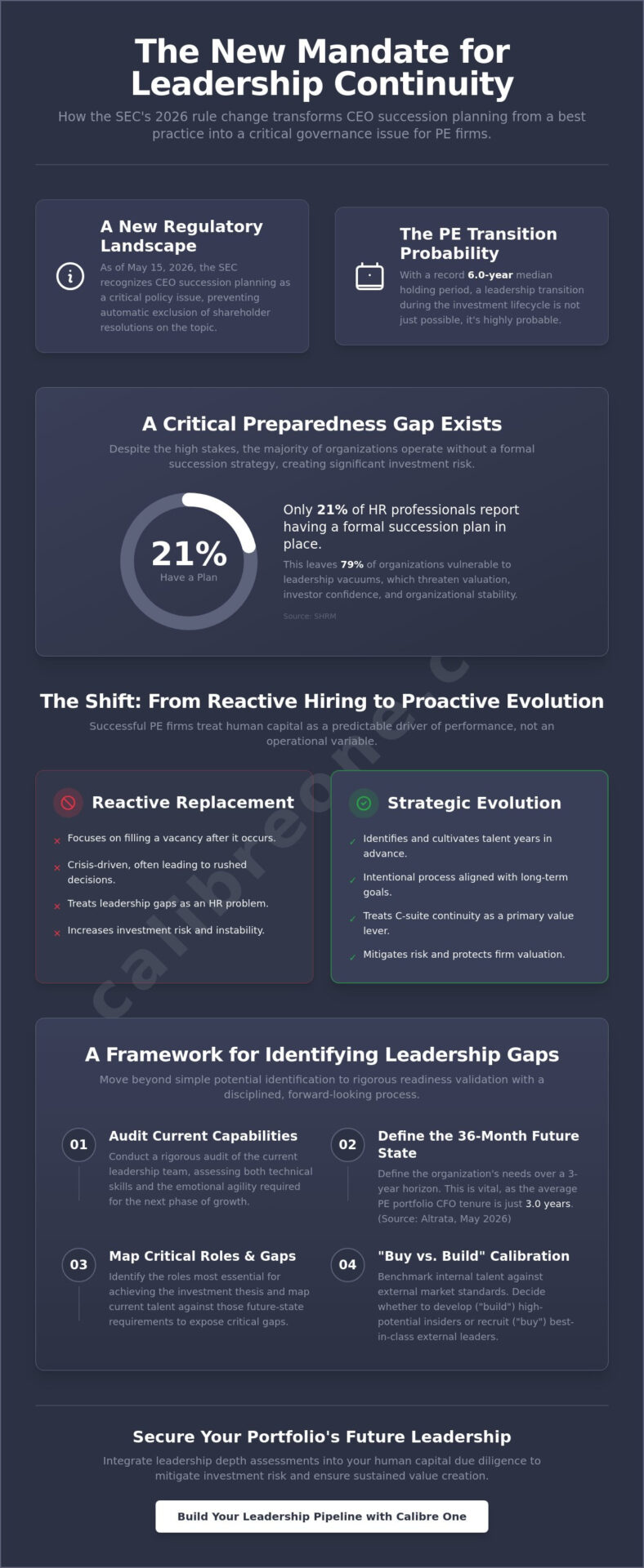
On May 15, 2026, the U.S. Securities and Exchange Commission (SEC) enacted a significant policy reversal that recognizes CEO succession planning as a critical policy issue essential to corporate governance. This regulatory shift means companies can no longer automatically exclude shareholder resolutions regarding leadership continuity, placing the bench strength of your C-suite under unprecedented scrutiny. In an environment where the median holding period for private equity-backed companies has reached a record 6.0 years, the probability of a leadership transition during the investment lifecycle is higher than ever, yet many firms remain unprepared for the high cost of a vacancy.
Just as Real Estate Investment Advisory is crucial for optimizing physical assets, specialized leadership planning is essential for maximizing the value of human capital in any portfolio.
We understand that a lack of internal talent readiness creates a dangerous misalignment between current capabilities and long-term growth goals. This guide offers a methodical process to identify and develop elite leadership, ensuring organizational stability and sustained value creation. You will gain a clear roadmap for transitions, learn to reduce investment risk through human capital due diligence, and cultivate a culture of continuous development. By moving beyond simple potential identification toward rigorous readiness validation, you ensure your portfolio companies are led by executives perfectly suited for scaling and transformation.
Key Takeaways
- Shift from reactive hiring to a proactive leadership evolution that treats C-suite continuity as a primary driver of long-term value.
- Learn to conduct a rigorous 36-month audit of your leadership team to identify and address critical talent gaps before they compromise growth.
- Master the “Buy vs. Build” calibration by benchmarking internal talent against external market standards to ensure best-in-class leadership.
- Utilize succession planning to create bespoke transition roadmaps that ensure a seamless handover and maintain organizational stability.
- Discover how to integrate leadership depth assessments into your human capital due diligence to effectively mitigate investment risk.
Table of Contents
-
Beyond Contingency: The Strategic Role of Succession Planning in PE
-
A Methodical Framework for Identifying Critical Leadership Gaps
-
Calibrating Internal Potential Against External Market Benchmarks
-
Executing the Succession Roadmap: From Development to Integration
-
Mitigating Investment Risk Through Human Capital Due Diligence
Beyond Contingency: The Strategic Role of Succession Planning in PE
Succession isn’t just about finding a replacement; it’s about the intentional evolution of the organization. Unlike traditional replacement hiring – which focuses on filling a vacancy after it occurs – strategic Succession planning identifies and cultivates talent years before a transition is necessary. In the high-stakes environment of PE, this process serves as a critical value lever. It transforms human capital from an operational variable into a predictable driver of portfolio performance. When firms view leadership through this lens, they stop seeing departures as crises and start seeing them as opportunities to recalibrate the team for the next phase of growth.
The Business Case for Intentional Leadership Evolution
A leadership vacuum is more than an HR challenge, it’s a direct threat to investor confidence and organizational stability. When a transition is planned, it protects the firm’s valuation by signaling to the market that the investment thesis remains on track. Despite the clear benefits, research from SHRM indicates that only 21% of HR professionals have a formal plan in place. For a PE firm, where the average holding period has reached a record 6.0 years, this lack of preparation is a significant risk. Leadership continuity is often the deciding factor in exit readiness. A buyer isn’t just purchasing assets; they’re investing in a team capable of sustained performance. By treating succession as a continuous governance responsibility, firms ensure that leadership depth remains a strength rather than a liability. For business owners in the architecture, engineering, and construction industries, Significant Business Results offers specialized assessments and exit strategy consulting to ensure leadership continuity and maximize firm value.
Aligning Talent Strategy with the Investment Thesis
A robust leadership pipeline must be a mirror of the firm’s specific growth goals. If the strategy involves rapid scaling or a pivot into new markets, the successor’s capabilities must align with that future state, not just the current requirements. This requires a meticulous calibration between the skills present today and the expertise required for a 36-month horizon. It’s about bridging the gap between current operational needs and the sophisticated demands of leadership excellence. When succession is integrated into the investment lifecycle from day one, it ensures that the talent strategy and the financial objectives are perfectly synchronized. This alignment isn’t a one-time event but a persistent effort to refine the organization’s human capital, creating a seamless path toward value creation.
A Methodical Framework for Identifying Critical Leadership Gaps
Identifying leadership gaps is a surgical exercise that moves beyond the surface of annual performance reviews. It requires a disciplined, four-step framework to ensure the talent pipeline is robust enough to withstand the pressures of a PE holding period. This process is both a defensive measure against volatility and an offensive strategy for growth. By applying a methodical lens to the current bench, boards can transform succession planning from an abstract concept into a tangible asset.
-
Step 1: Conduct a rigorous audit of current leadership team capabilities, assessing not just historical success but the technical and emotional agility required for the next phase of the investment.
-
Step 2: Define the future state of the organization over a 36-month horizon. This timeline is vital, as Altrata research (May 2026) indicates the average CFO tenure in PE portfolio companies is just 3.0 years, making a transition statistically probable during the investment lifecycle.
-
Step 3: Map critical roles essential for achieving the investment thesis, ensuring the most vital seats are occupied by those with the specific muscle memory for the task at hand.
-
Step 4: Identify potential vacancies and high-risk, single-point-of-failure positions where a sudden departure could derail value creation.
Effective succession planning creates a bridge between today’s stability and tomorrow’s growth, providing the clarity needed to make difficult talent decisions early.
Defining the Competencies of the Future
The leadership requirements for technology-driven sectors are shifting rapidly, moving away from pure operational oversight toward a focus on transformation and scaling – a trend that has been further accelerated by the widespread adoption of AI. To remove bias, firms must replace subjective "gut feelings" with data-driven assessments that measure a candidate’s capacity for ambiguity and high-stakes decision-making. This shift ensures the organization isn’t just hiring for what it used to be, but for the complex, tech-enabled entity it is destined to become. It is a process of calibrating current strengths against future demands.
Identifying High-Potential Internal Talent
Identifying successors requires a clear distinction between high performance and high potential. While an executive might excel in their current role, the transition to the C-suite demands a different set of behavioral competencies. Utilizing objective behavioral assessments allows boards to gauge readiness with precision, identifying those who can handle the increased complexity of a top-tier role. Providing a transparent roadmap for these high-potentials doesn’t just prepare them for the future; it also acts as a powerful retention tool for the talent you cannot afford to lose.
Calibrating Internal Potential Against External Market Benchmarks
Succession planning is often viewed as an internal exercise, yet its true efficacy is measured by how internal candidates compare to the highest standards of the global market. The Buy vs. Build dilemma is particularly acute in PE, where the record 6.0-year median holding period (McKinsey, 2026) leaves little room for protracted learning curves. If the goal is a rapid exit at a premium valuation, the leadership team must be beyond reproach. A partner-led search firm acts as a discerning strategic partner, providing the nuanced intelligence required to validate whether an internal successor can outperform an external heavyweight.
Establishing a benchmark for best-in-class requires looking beyond past successes to the specific demands of the future. For 2026, there is a marked shift in demand toward revenue-focused leaders, such as Chief Revenue Officers and Chief Growth Officers, as firms pivot from financial engineering to organic growth. In technology-driven sectors, this external perspective is often the catalyst needed to break through stagnant innovation cycles and implement modern, scalable architectures. This calibration ensures that the organization is not just promoting the best person in the room, but the best person for the investment’s ultimate destination.
The Case for External Executive Search
External talent is frequently the bridge between a company’s current state and its target valuation. When a portfolio company requires a complete cultural overhaul or a complex digital transformation, an external hire brings the objective perspective and elite experience necessary to drive that change. Global search partners excel here by accessing high-level talent that isn’t found on traditional job boards, ensuring a meticulous selection process for high-stakes C-suite roles. This external infusion of talent is often what differentiates a standard performance from an exceptional exit.
Integrating External Hires with Internal Successors
The introduction of an external leader shouldn’t signal the end of internal development. Instead, it should be a strategic blending of fresh innovation and institutional knowledge. Managing these cultural dynamics is essential to prevent attrition among high-potential internal talent who may feel bypassed. By ensuring complete alignment between the Board and the incoming leadership, firms can create a unified front that supports the new executive while continuing to nurture the internal pipeline for future roles. This dual approach creates a resilient leadership structure that is both stable and adaptable.
Executing the Succession Roadmap: From Development to Integration
Execution is the pivot point where succession planning transitions from a strategic vision into a tangible leadership reality. It isn’t enough to simply identify a successor; the organization must actively bridge the gap between their current capabilities and the multifaceted demands of the C-suite. This involves creating bespoke development plans that address specific skill deficits while maintaining the leader’s unique strengths. It’s a delicate balance of both nurturing individual talent and safeguarding the firm’s operational stability.
A successful handover typically follows a 12 to 36 month timeline, providing sufficient runway for the successor to absorb the complexities of the role without the pressure of an immediate vacancy. During this period, high-level executive coaching becomes an essential tool to accelerate readiness. By focusing on readiness validation, a key 2026 trend, rather than just potential, boards can ensure that the individual is prepared to perform in a higher-stakes environment on day one. Establishing clear KPIs, such as the achievement of specific developmental milestones or the successful management of high-impact projects, allows the Board to measure the progress of the program with clinical precision.
Structured Mentorship and Leadership Development
Effective development pairs potential successors with current leaders or Board members, fostering a mentorship dynamic that is both strategic and instructional. This exposure allows the individual to navigate critical business functions outside their immediate expertise, building a comprehensive view of the enterprise. The focus here often shifts toward the refined soft skills of leadership, such as persuasion, resilience, and executive presence, which are as vital to C-suite success as financial or technical acumen. It’s about providing the successor with the institutional wisdom that only comes from direct proximity to the current leadership.
The Integration Phase: Ensuring Day One Success
The final stage is the integration phase, where a comprehensive transition plan outlines specific responsibilities during the handover. Transparent communication with key stakeholders is paramount to maintain organizational trust and prevent the uncertainty that often accompanies leadership changes. Monitoring the first 100 days of a new leader ensures they remain aligned with the investment thesis and the Board’s long-term vision, providing a safety net that protects the company’s momentum during the most vulnerable period of a transition. This methodical approach ensures that the new leader doesn’t just start the role, but thrives in it.
Mitigating Investment Risk Through Human Capital Due Diligence
Human capital is frequently the most opaque component of a private equity transaction, yet it remains the most potent lever for value creation. Integrating succession planning into the pre-acquisition due diligence process allows PE partners to move beyond financial metrics and into the operational reality of the business. By evaluating the leadership bench before the deal closes, firms can identify whether the existing management team possesses the specific agility required to execute the investment thesis. It’s a process of identifying both the immediate strengths of the C-suite and the latent risks that could emerge if a key leader departs during the first year of ownership.
A sophisticated analysis of leadership depth provides a clear picture of the investment’s overall risk profile. In complex, highly regulated environments like healthcare and life sciences, the technical and clinical expertise of the leadership team is non-negotiable.
Evaluating Leadership Depth Pre-Acquisition
The strength of a management team during the deal process is often a leading indicator of portfolio performance. Identifying high-risk, single-point-of-failure positions early allows PE partners to plan for necessary interventions before they become crises. This analysis should include a granular assessment of how the current team’s capabilities align with the 36-month growth plan. By uncovering talent-related risks during the due diligence phase, firms can adjust their integration strategies or even their valuation models to reflect the true state of the organization’s human capital bench.
Building High-Performing Teams for the Long Term
The Board of Directors plays a pivotal role in overseeing the continuous evolution of the leadership pipeline. This isn’t a task that can be delegated and forgotten; it requires a persistent partnership between the Board, the PE firm, and an elite executive search partner. This collaboration ensures that the leadership team remains dynamic and aligned with the shifting demands of the market. To understand how this methodical approach translates into real-world results, we invite you to explore our global client success stories. Ultimately, mastering the art of succession planning is what distinguishes a successful investment from a transformative one, serving as a pillar of strategic mastery that ensures value creation is both deliberate and enduring.
Securing the Future of the Portfolio
Building a resilient C-suite requires a shift from viewing leadership transitions as isolated events to embracing them as a continuous governance responsibility. By integrating rigorous human capital due diligence and objective market benchmarking, firms can transform the statistical certainty of turnover into a structured opportunity for value creation. This methodical approach ensures that your leadership pipeline is not just a contingency plan, but a strategic asset that aligns perfectly with your long-term investment thesis.
Frequently Asked Questions
What is the difference between succession planning and replacement planning?
Replacement planning is a defensive measure focused on identifying immediate backups for critical roles in the event of an emergency, whereas succession planning is a proactive, long-term strategy. While replacement focuses on narrow role continuity, succession is an offensive process of developing a diverse talent pipeline to meet future organizational needs. It ensures leadership evolution is aligned with the long-term investment thesis rather than just filling a sudden vacancy.
How long does a typical succession planning process take to implement?
A robust implementation typically requires a 12 to 36 month horizon to move from identifying potential to validating true readiness. This timeline provides the necessary runway for successors to undergo high-level executive coaching and gain exposure to critical business functions outside their current expertise. It transforms the transition into a gradual integration, ensuring the new leader is prepared to perform in a high-stakes environment from day one.
Why is succession planning particularly critical for PE-backed companies?
With CEO replacement rates exceeding 70% during the average investment holding period, leadership turnover is a statistical certainty in the PE world. Since median holding periods have reached a record 6.0 years according to McKinsey research, the probability of a transition during the investment lifecycle is high. Proactive planning mitigates the risk of a leadership vacuum that could stall growth goals or negatively impact the final exit valuation.
How do we identify internal talent with true C-suite potential?
Identifying true potential requires moving beyond historical performance and utilizing objective, data-driven behavioral assessments to remove bias. It’s essential to distinguish between a high-performing functional manager and an executive with the agility to navigate the ambiguity of the C-suite. Boards should validate readiness through high-impact projects and benchmark internal candidates against the highest standards of the external global market to ensure best-in-class leadership.
What role does the Board of Directors play in the succession process?
The Board acts as the ultimate steward of the succession process, ensuring that the talent strategy remains synchronized with the firm’s growth objectives. They provide the necessary oversight to maintain a culture of continuous development and are responsible for the final selection and integration of new leaders. This is a persistent governance responsibility that should begin at the start of an investment, rather than being triggered by a departure.
Can succession planning improve employee retention and morale?
Yes, a transparent and structured succession planning program significantly improves retention by providing high-potential leaders with visible, long-term career paths. When top-tier executives see a deliberate investment in their professional evolution, it builds organizational trust and loyalty. This sense of stability and professional growth fosters a high-performance culture where elite talent feels deeply valued and remains engaged throughout the investment lifecycle.
When should we look externally for a successor instead of promoting from within?
An external search is often necessary when the investment thesis requires a significant cultural overhaul or a specialized skill set not currently present within the organization. If the company is entering new, technology-driven sectors or needs to implement rapid, transformative change, external hires bring the fresh perspective and elite experience required. It is a strategic choice made when the internal pipeline cannot meet the complexities of the future state.
How do we handle the communication of a succession plan to the wider organization?
Communicating the plan requires a balanced approach that emphasizes organizational stability while maintaining the necessary confidentiality for the individuals involved. Boards should draft a comprehensive communication strategy that addresses key stakeholders, including employees, investors, and customers, at specific milestones. Clear, consistent messaging prevents uncertainty and ensures the organization understands that the transition is a planned, strategic evolution designed to support sustained value creation.